


Total addressable market is presented as a number, as if it were measured. It's a narrative dressed as arithmetic — and betting strategy on it is how companies chase markets that don't exist.
Slide 8 of nearly every pitch deck carries the same line: "$47B market." Sometimes it's $12B, sometimes $300B, but the format is fixed — a clean figure, a source in light gray underneath, the implication that someone went out and measured the world and came back with this. The number does a lot of work in the room. It makes the opportunity feel large, the bet feel justified, and the ambition feel grounded in fact.
It almost never is. That figure was not measured. It was constructed, usually backward from a conclusion the author had already reached.
A total addressable market is a story about how big something could be if a long chain of assumptions all held at once. The arithmetic is real — population times price, multiplied out — but arithmetic on top of invented inputs is still invention. The dangerous part is that the multiplication launders the assumptions. By the time the product of guesses reaches the slide, it wears the authority of a measurement it never earned.
The number is built to reach a conclusion
Most TAMs are reverse-engineered. The author knows what the number needs to clear — large enough to raise a round, large enough to greenlight the bet, large enough to make a board comfortable — and then assembles the inputs that get there. Choose a generous population, attach a confident price, fold in an adjacency or two, and the answer obliges. The method looks like discovery. It functions as justification.
Watch what the construction quietly assumes. It assumes everyone in the counted population has the problem you solve. It assumes they'd pay roughly the price you picked. It assumes they'd pay it for your version rather than the incumbent's, the spreadsheet they already use, or nothing at all. And it assumes they'd do all of this now, not in some indefinite future when the category is mature. Each assumption is buried inside a multiplication where no one has to defend it line by line.
Visual 1 — Top-down TAM story vs. bottom-up reality
Method | What it assumes | What it hides |
|---|---|---|
Top-down TAM story | Everyone in a large population has the problem and will pay the chosen price | Whether any specific buyer will pay this much for this, now — and whether you can even reach them |
Bottom-up reality | Only that a defined set of reachable buyers, counted one segment at a time, will convert at an observed rate | Almost nothing — the assumptions are explicit, smaller, and testable against real pipeline |
How to read it: the top-down number is bigger and feels objective; the bottom-up number is smaller and is actually true. Only one of them you can act on tomorrow.
The seduction is structural. A big TAM flatters everyone at the table. Investors want a market large enough to return a fund, so a nine-figure number reads as a green light rather than a warning. Founders want the bet to matter, and a vast market makes the years of effort feel proportionate. Boards want comfort, and a large denominator makes any current revenue look like the early edge of something inevitable. Nobody in the room is incentivized to shrink the number, so it grows.
The reachability gap
The flaw a big TAM hides best is the distance between the market that exists and the market you can actually touch. These are not the same set, and the gap between them is where strategies go to die.
A market can be genuinely enormous and almost entirely unreachable by you. The buyers may be locked into incumbents with switching costs you can't overcome. They may be distributed across channels you have no way to enter economically. They may have the problem but not the budget, the budget but not the authority, or the authority but not the urgency. A TAM counts all of them as if a dollar of their spending were a dollar you could win. Most of it isn't even theoretically available to your company, with your product, your distribution, and your runway.
The most dangerous TAM isn't the inflated one. It's the big one that's technically true and practically unreachable — a real ocean you have no boat to cross.
That's the counterintuitive turn. An inflated TAM gets caught eventually; someone checks the math. The technically-true-but-unreachable TAM survives scrutiny precisely because it's defensible. The number is real. The market is real. What's missing is any honest account of how this particular company, from where it stands, reaches and converts a meaningful slice of it before the money runs out. The figure passes diligence and the strategy still walks off a cliff.
Visual 2 — The reachability gap
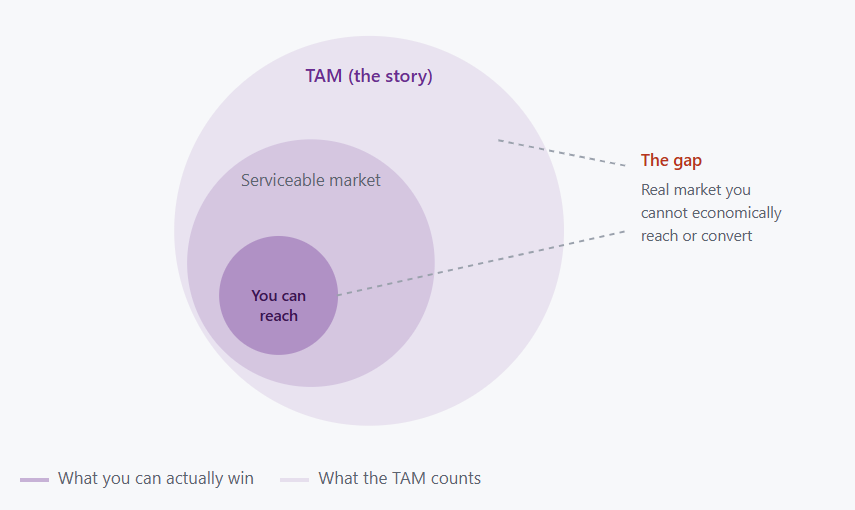
Conceptual model. The TAM is the outer ring. The bet lives in the small inner circle — the buyers you can reach, afford to acquire, and convert. The space between is the reachability gap that no slide admits to.
The honest method points the other way
Bottom-up sizing reverses the direction of the lie. Rather than starting from a population and dividing toward you, it starts from you and builds outward. How many of this specific kind of buyer exist? How many can you reach through channels you actually operate? At what rate do they convert when you talk to them, and at what price will they sign? Multiply those, and you get a number that is smaller, less flattering, and worth infinitely more, because every input was earned rather than assumed.
A small, real, reachable market beats a giant TAM story in every case that matters. The reachable market tells you what to do on Monday: which buyer, which channel, which price, which motion. The TAM story tells you only that, in principle, a lot of money exists somewhere. One is a map. The other is a postcard of a country you may never visit.
What this means for leaders
Treat the TAM slide as a claim, not a fact. When a number is presented as measured, ask who measured it and how. If the answer is population times price with three assumptions stacked underneath, you're looking at a narrative. Read it as one and you'll stop letting it carry weight it can't bear.
Build the bet on the bottom-up number. The figure that should drive resourcing isn't the addressable universe; it's the reachable-and-convertible market you can defend buyer by buyer. It will be smaller and it will be sobering, and that's exactly what makes it useful for allocating real money and real people.
Interrogate reachability before size. The right question is never just "how big is the market." It's "how much of it can this company, from here, actually reach and convert before the runway ends." A market you can't get to is not your market, no matter how true the number is. The discipline is to fall for the slice you can win, not the ocean you can only point at.
A LookatBusiness original.