


The marketing funnel assumes buyers move in a tidy line from awareness to purchase. Real buyers loop, lurk, research in private, and show up ready to buy from a shortlist you never knew you were on.
A buyer you'd never spoken to once filled out a demo form, and within two weeks signed a six-figure contract. The sales team called it a fast cycle. It wasn't. By the time that form arrived, the buyer had spent four months reading, asking around, lurking in a Slack community, and quietly narrowing a list of vendors to two. You weren't a lead being nurtured. You were a decision already mostly made, surfacing at the only moment your analytics could see.
That gap — between when the buying actually happened and when you finally measured it — is the whole problem with the funnel.
The funnel is a beautiful object. Awareness at the top, consideration in the middle, purchase at the narrow end, prospects descending in an orderly trickle. It gives marketing a model, a vocabulary, and a dashboard. There's just one issue. Buyers don't move through it.
The tidy fiction
The funnel's appeal is that it makes buying look like a manufacturing process. Pour leads in the top, apply stages, measure conversion at each gate, and revenue comes out the bottom. Every step is a metric, every metric a lever. It's a model a finance team can love.
Actual B2B buying refuses to behave that way. Gartner's research describes the journey not as a line but as a loop — buyers cycling repeatedly through a set of "jobs" (problem identification, solution exploration, requirements building, vendor selection) in no fixed order, revisiting each as new questions surface. A buyer can be deep in vendor selection and lurch back to "wait, what problem are we actually solving?" The arrow doesn't point down. It circles.
So the first thing the funnel gets wrong is its shape. The second thing it gets wrong is far more expensive: where the buying happens.
Visual 1 — The funnel vs. the real journey
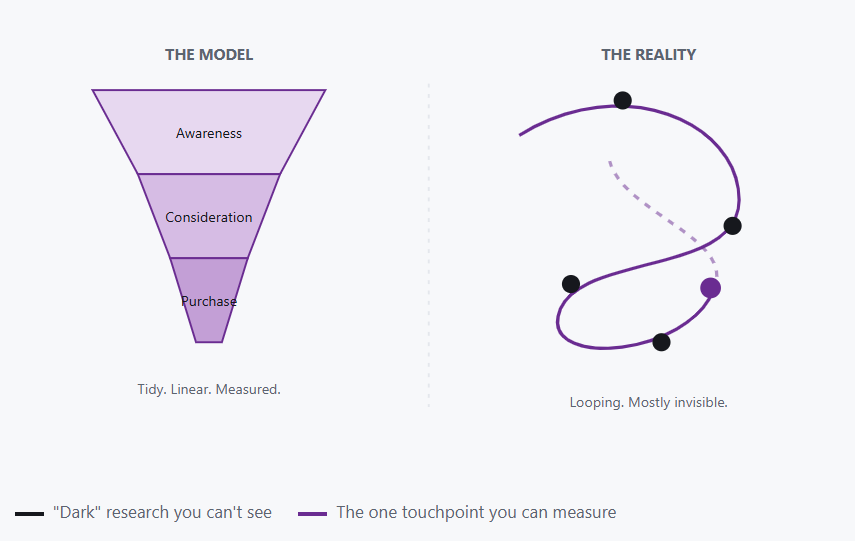
Conceptual model. The funnel assumes a clean descent. The real journey loops back on itself, and the decisive moments (black dots) happen in channels your attribution never records.
How buying actually happens
Here's the figure that should keep every CMO honest. Across the entire B2B purchase, buyers spend just 17% of their time with potential suppliers. The remaining 83% is independent: self-directed research, peer conversations, communities, search, comparison, and internal debate — most of it complete before a salesperson is ever engaged. By the time a buyer raises a hand, a large majority of the journey, commonly cited at around 80%, is already behind them.
And buyers increasingly prefer it that way. Roughly two-thirds to 70% say they want a rep-free, self-service buying experience, at least until late in the process. They'd rather read, click, compare, and decide on their own terms than sit through a discovery call. The control has shifted to the buyer's side of the table, and it isn't shifting back.
Put those facts together and the funnel's premise collapses. You can't shepherd buyers stage-by-stage down a path they're walking privately, at their own pace, in places you don't control and can't see.
The dark journey
Most of the buying decision forms in what's often called "dark social" — the unmeasured channels where real opinions get made. A Slack group where a peer mentions which tool actually worked. A WhatsApp thread between two heads of ops. A podcast on a commute. A Reddit comment. A conversation at a conference dinner. None of it shows up in your CRM. All of it shapes whether you make the shortlist.
By the time the buyer surfaces — fills out a form, replies to an email, books a demo — the shortlist is usually set. You're not being evaluated. You're being confirmed, or you're not there at all. The decision about whether you'd be considered was made weeks earlier, in rooms you had no presence in.
This is why so many companies feel like they're "competing on price at the end." They're not. They lost the real contest months earlier, in the dark, and only meet the buyer once the field has narrowed to the names that earned trust before the form was filled.
The attribution trap
Now the contrarian turn, and it cuts against everything a modern marketing org is built to do.
The most important part of your buyer's journey is the part you cannot measure — and the obsession with tracked, attributable funnels actively blinds you to where decisions are actually formed.
What you can measure is the small, visible tail of the journey. What decides the outcome is the long, dark body of it. Optimize only for what's trackable and you'll pour your budget into the 17% the buyer barely cares about.
Attribution rewards the last clean click. So budget flows to the channels that take credit at the bottom — branded search, retargeting, the demo form — because those are the touchpoints a dashboard can claim. Meanwhile the activities that actually put you on the shortlist (showing up in the communities, earning the peer recommendation, being the name someone trusts enough to mention) generate no clean attribution and so get starved. The measurement system quietly steers spend away from where buying happens and toward where it merely gets recorded.
Companies that manage strictly to a funnel are optimizing a journey their customers don't take. They mistake the part they can see for the part that matters.
Visual 2 — Assumption vs. reality
Funnel assumption | Buyer reality | |
|---|---|---|
Path shape | A straight line, top to bottom | A loop that doubles back on itself |
Where it happens | In your channels, on your forms | In dark, self-directed, peer channels |
What's measurable | Most of it, stage by stage | The small visible tail; the body is invisible |
Implication | Move leads down the stages | Be present and trusted before the journey surfaces |
How to use it: if every line in your marketing plan maps to the left column, you're investing in the visible 17% and ceding the 83% that decides who makes the shortlist.
What this means for leaders
Build presence where buyers actually research, not where you can track them. That means investing in the communities, peers, search results, and self-serve material your buyers use in private — even though the return won't show up cleanly in any attribution model. The goal is to be on the shortlist before the buyer ever identifies themselves to you.
Stop punishing the channels you can't attribute. The reflex to defund anything that doesn't produce a tracked conversion is how companies systematically starve the work that wins. Treat dark, unmeasurable influence as a cost of being considered, and judge it by share of shortlist and inbound quality, not by last-click credit.
Measure readiness, not stage progression. The useful question isn't "how many leads are in consideration?" It's "when buyers in our category make a shortlist, how often are we on it — and how warm are they when they arrive?" A pipeline of self-educated buyers who already trust you is worth more than a fat funnel of contacts you're trying to drag downhill.
The funnel will stay on the wall because it's tidy and it fits a slide. Just don't confuse the diagram with the customer. The buyer isn't descending your stages. They're off doing their own research, looping back, asking a friend, and deciding — long before they let you know they exist.
Sources: Gartner, The B2B Buying Journey (~17% of the journey spent with suppliers; the looping, non-linear nature of B2B buying jobs), and Gartner survey on rep-free buying (~67–70% of buyers prefer a self-service experience).