


B2B sales and marketing still talk about "the buyer" as if it's one person. The real buyer is a group of six to ten people who mostly disagree, and your pitch has to survive a room you're never in.
The deal looked won. The economic buyer loved the demo, the budget was confirmed, the champion was texting you emojis. Then the proposal sat. A week passed, then three. When the rejection finally came, the reason had nothing to do with anything you'd discussed: the security lead had raised a concern in a meeting you weren't in, the head of ops wanted a vendor she'd used before, and your champion — who genuinely wanted you — couldn't carry the room alone.
You didn't lose to a competitor. You lost to a conversation you never heard.
This is the part of B2B selling that almost every playbook gets wrong. We build pitches, personas, and pipelines around an individual — "the buyer," singular, the one whose hand we shake. But the buyer is a fiction. The decision belongs to a group, and that group does most of its real work when no salesperson is anywhere near the room.
The myth of "the buyer"
Walk through any sales-enablement deck and you'll find a single avatar: a job title, a headshot, a tidy list of pain points. It's a comforting abstraction because it makes the sale legible. Persuade this one person, the logic goes, and the order follows.
The trouble is that the person you've spent months persuading rarely has unilateral authority to buy. In a typical complex B2B purchase, Gartner finds the buying group runs to six to ten people, and once you count everyone who touches the decision — the influencer who forwarded an article, the finance partner who models the contract, the IT reviewer who has to sign off on the integration — the count climbs to roughly thirteen. Each arrives with a different mandate. Each can stall the deal. Most can't, on their own, approve it.
So the real unit of B2B buying isn't a person. It's a fractious committee, and the people in it frequently want different things.
Visual 1 — One seller, one committee
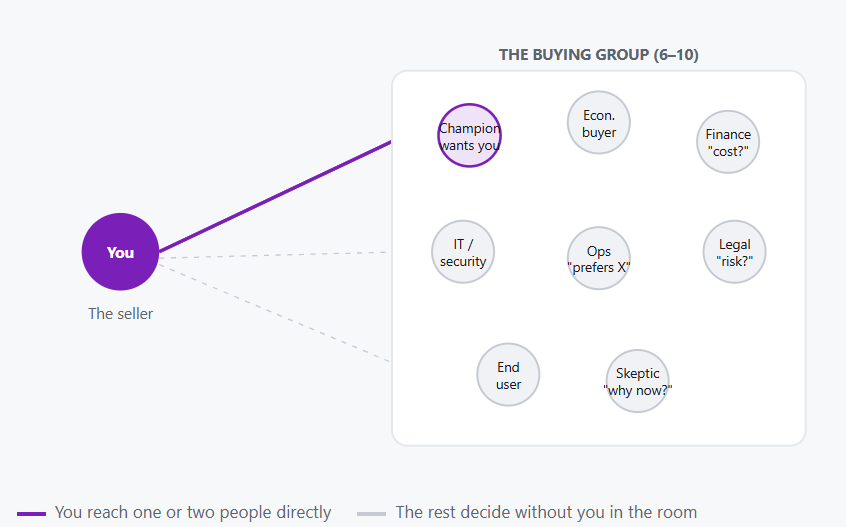
Conceptual model. You speak to a champion and maybe one other. The remaining six-to-eight form their view in meetings, hallways, and Slack threads you'll never see — each weighing a different priority.
The deliberation you never see
Here's the number that should reorganize how you sell. Across an entire B2B purchase, buyers spend only about 17% of their time meeting with potential suppliers — and when they're weighing several vendors, any single sales rep gets roughly 5 to 6% of the total journey. The other 83% happens elsewhere: in independent research, in internal debate, in side conversations among colleagues who are comparing notes about you while you're not there to answer.
Sit with that. The overwhelming majority of the buying decision is formed in a room you have no access to. Your most persuasive moment isn't the demo. It's the Tuesday-afternoon meeting where your champion has to explain, defend, and re-sell your case to seven skeptical peers — using only what you handed them and whatever they can remember.
This is the consensus problem, and it is brutal. Gartner's research is blunt about it: the more stakeholders involved, the harder it becomes for the group to agree on anything, and the likelier the whole purchase ends in "no decision." The enemy of your deal isn't the rival vendor. It's the inability of eight busy people to reach agreement.
Your champion's real enemy
Which brings us to the turn most sellers resist. We're trained to obsess over the competition — to win the bake-off, to out-feature the alternative, to position against the other logo in the consideration set.
But your champion's biggest obstacle usually isn't your competitor. It's their own colleagues.
You don't lose most B2B deals to a rival. You lose them inside the customer's own organization — in the meeting where your champion runs out of answers and the group quietly decides to do nothing.
The deal is won or lost internally. Your champion is standing in front of finance, ops, security, and a skeptic who's seen three failed tools, trying to hold a fragile coalition together. If they fumble the finance objection, the deal slips. If they can't answer the security question, it stalls. The competitor you've been war-gaming against is often irrelevant; the group never gets far enough to choose between vendors because it can't get past its own disagreements.
This reframes your job entirely. You are not closing a buyer. You are arming an advocate to win an argument you won't be present for.
Selling to the room you're not in
Once you accept that the decision is a group negotiation conducted offstage, the work changes shape.
Equip the champion to sell, not just to like you. Liking your product is necessary and nowhere near sufficient. Your champion needs the ammunition to win specific internal fights: a one-page business case finance can't poke holes in, a security brief IT can forward without translating, a crisp answer to "why now" for the skeptic. If your sales collateral only persuades the person reading it, it dies the moment it enters the committee.
Sell to the objections you'll never hear. Map the buying group before you map the close. Who has a veto? Whose preferred vendor are you displacing? Where does the budget conversation get ugly? Then hand your champion pre-built answers to questions raised by people you'll never meet. You're not writing for your reader; you're writing for your reader's hostile audience.
Design for consensus, not for a single yes. A signature from your champion isn't the finish line — it's permission to start the real campaign. The proof a committee needs is different from what an individual enjoys: third-party validation the skeptic will trust, a reference from a peer in the same role, a risk narrative that lets the cautious say yes without staking their reputation. Build for the group's lowest-confidence member, because that person sets the pace.
Visual 2 — Two different sales
Selling to a person | Selling to a committee | |
|---|---|---|
Who decides | One buyer you can name | Six to ten people, most of whom you never meet |
Where it's decided | In the room with you | In internal meetings you're not invited to |
What wins | The best demo and the best rep | A champion who can win the argument without you |
Your real job | Persuade and close | Arm an advocate and engineer group consensus |
How to use it: if your sales motion lives entirely in the left column, you're optimizing for a decision that gets made in the right one.
What this means for leaders
Audit your content for the committee, not the contact. Pull your top sales assets and ask a hard question of each: could a champion forward this, unedited, to a hostile finance lead and have it do the arguing for them? If your material only works when a rep is in the room narrating it, you've built nothing for the 83% of the journey where no rep is present.
Measure stakeholder coverage, not contact count. Most pipeline reviews ask whether the deal has a champion. The better question is how many of the buying group you've reached, and which veto-holders remain dark. A deal with one enthusiastic champion and four unmapped skeptics is not a strong deal. It's a coin flip you've mistaken for momentum.
Treat "no decision" as your true competitor. Your sharpest rival is rarely another vendor — it's the group's failure to agree, which resolves as inertia. Build your motion to reduce the cost and risk of saying yes for the most nervous person in the room. Win that person, and the committee can finally move.
The shake of a hand still matters. It's just not where the deal is decided. The decision happens later, behind a closed door, in an argument you helped your champion win or quietly lost by leaving them to fight it alone.
Sources: Gartner, The B2B Buying Journey (buying-group size, ~17% of journey spent with suppliers, ~5–6% with any single rep), and Gartner sales survey on rep-free buying.