


Every startup wants to "create a category." For most, it's the most expensive marketing project they'll ever fund and the one least likely to pay off.
There's a moment in nearly every Series A pitch where the founder leans in and says it: "We're not competing in an existing market. We're creating a new category." Heads nod. It sounds like the most ambitious thing a company can attempt — to name a new kind of problem, plant a flag, and own the language an entire market will use.
It's also, for most companies that attempt it, the beginning of an expensive mistake.
Category creation has been mythologized into the highest form of positioning, the move that turns a startup into a movement. The myth is built on a handful of dazzling successes and a vast, unmentioned graveyard. For every company that genuinely created a category and got rich doing it, dozens spent their runway teaching a market a lesson it never showed up to learn.
The allure
The appeal is real and worth naming honestly. If you create the category, you define it. You write the criteria buyers use to evaluate everyone, including you, and you write them in your favor. You become the default, the reference, the company the analysts call first. Done right, category creation isn't a marketing tactic; it's a moat made of language.
And the case studies are intoxicating. The CRM company that named a software model. The inbound-marketing pioneer that coined the term and then owned it. The data-warehouse player that defined a new tier of infrastructure. These stories get told and retold until "create a category" sounds less like a gamble and more like a recipe.
The recipe leaves out the bill.
The hidden bill
When you enter an existing category, the market has already done your hardest work for you. Buyers know the problem exists. They have a budget line for it. They know roughly what a solution looks like and how to evaluate one. Your job is comparison: be better, be different, be the obvious pick among known options.
When you create a category, none of that exists yet. You have to convince a market that a problem it isn't thinking about is worth solving, that a budget that doesn't exist should be created, and that a solution it has never heard of belongs on a shortlist it hasn't started building. That's not selling. That's education — slow, repetitive, expensive education — and you pay for all of it before a single comparison shopper ever arrives.
The bill comes due in three currencies. Cash, because evangelism is a marketing line item with no ceiling. Time, because markets don't get educated in a quarter; they get educated over years, and your runway is measured in months. And focus, because every dollar spent teaching the market the problem exists is a dollar not spent winning customers who already know it does.
Visual 1 — Two very different games
Create a category | Win an existing one | |
|---|---|---|
Cost | Very high — you fund market education from scratch | Lower — the market already understands the problem |
Time to payoff | Years, if ever | Quarters, against a known demand curve |
Primary risk | The market never shows up; you run out of runway | Crowded; you must be genuinely different to win |
When it makes sense | A real, unserved problem + capital + patient years | Almost always, if you can be clearly better |
How to use it: be honest about which column you're actually in. Most companies claiming the left are really competing in the right and would rather not admit it.
Survivorship bias, dressed as strategy
The famous category creators are a survivorship-bias illusion. We study the ones that worked because the ones that didn't disappeared quietly, taking their cautionary tale with them. We never tally the companies that coined a clever term, ran the evangelism playbook, published the manifesto, hosted the conference — and folded before the market they were teaching ever materialized.
The base rate is brutal precisely because the mechanism is so demanding. To create a category you must be right about a problem the market hasn't noticed, early enough to plant the flag but not so early that you bleed out waiting, well-funded enough to teach for years, and lucky enough that the timing breaks your way. Get any one of those wrong and the whole project becomes an elaborate way to spend your investors' money explaining a problem nobody asked you to solve.
Which leads to the uncomfortable diagnosis.
"We're creating a new category" is, more often than not, a confession dressed as a boast — the tell of a company that can't articulate why it's better than the alternatives buyers already know.
When a founder can't say crisply why they beat the incumbents in a known category, the temptation is to escape the comparison entirely by declaring the category new. No competitors, no benchmarks, no awkward feature-by-feature loss. But a market with no competitors is usually a market with no buyers. The absence you're celebrating is often the absence of demand.
When it genuinely makes sense
None of this means category creation is never right. It means the conditions are rare and worth stating plainly, because almost nobody who invokes them actually has them.
It can work when there's a genuinely unserved problem — not an underserved one, an unserved one — that buyers feel acutely but have no name or budget for. It can work when you have the capital to fund years of patient evangelism without the clock killing you first. It can work when a real shift, technological or regulatory, has created a problem that didn't exist before and incumbents can't reframe to claim. And it tends to work only for a team that can execute the education relentlessly, for longer than feels reasonable, without flinching.
That's a demanding stack of conditions. If you can't check all of them honestly, you're not a category creator. You're a competitor looking for an exit from a fight you'd rather not have.
The cheaper game worth playing
The alternative most companies should choose is less glamorous and far more reliable: enter an existing category and win it by being different.
The demand is already there. The budget already exists. The buyer already knows the problem and is actively shopping. You don't have to teach them the problem is real; you only have to convince them you're the best answer to a question they're already asking. That's a winnable fight, and it's winnable in quarters rather than years.
The trick is that "different" has to be real. Entering a known category without a sharp, defensible difference just makes you one more option in a crowded list. But sharpening a genuine difference inside an existing category is a vastly cheaper and higher-odds project than conjuring a market from nothing — and it scratches the same ambition. You can still end up owning the category. You just win it from inside, by being the best, instead of inventing it from outside and praying anyone shows up.
Visual 2 — The cost of teaching a market
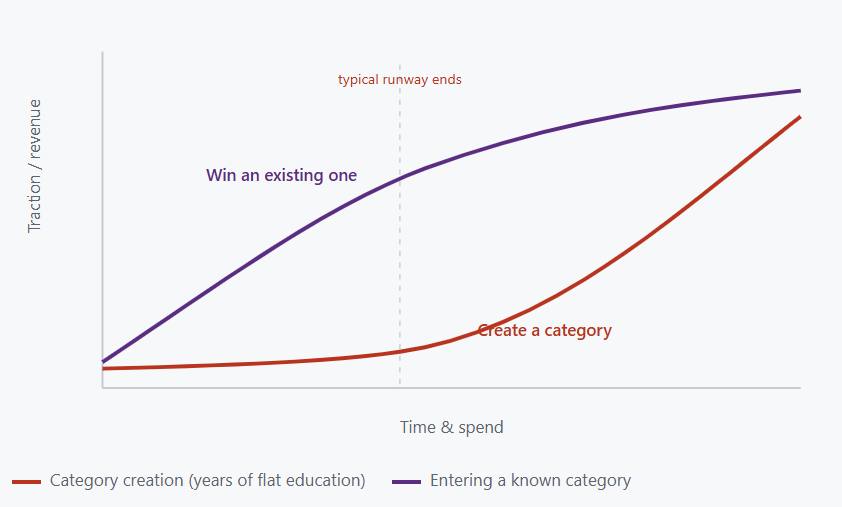
Conceptual model. Category creation spends years teaching the market before traction arrives — often past the point the runway runs out. Entering a known category meets demand that already exists.
What this means for leaders
Diagnose which game you're in before you fund either. Ask whether buyers already feel the problem and budget for it. If they do, you're in an existing category whether your deck says so or not, and you should compete like it. If they genuinely don't, be sure you have the years and the capital before you sign up to teach them.
Treat "no competitors" as a warning, not a win. An empty competitive field usually signals absent demand, not untapped opportunity. Before you celebrate having no rivals, prove that buyers are actively looking for what you sell. A market you have to create from scratch is a liability dressed as whitespace.
Earn the right to claim a category by winning a real one first. The companies that successfully created categories almost always had a working business inside a known one before they renamed the game. Win where demand already exists, build the proof, and let the category emerge from your traction — rather than betting the company on inventing one from nothing.
Ambition isn't the problem. Misdirected ambition is. The market doesn't hand its biggest rewards to the company that wanted to invent something new. It hands them to the company that showed up where buyers already were and was simply, unmistakably, the better choice.
A LookatBusiness original.