


Founders chase the biggest market they can credibly claim. The ones who win usually dominate a market so small it looks unambitious — then expand from a position of total control.
Read the first slide of almost any seed deck and you'll meet the same number: a market measured in the tens of billions. The founder has done the arithmetic — total spend in the category, a modest share assumed, a line that bends up and to the right. The pitch is that the prize is enormous and the team intends to take a sliver of it.
A sliver of enormous is the weakest position in business. And founders keep choosing it on purpose.
The instinct is understandable. A big number signals ambition, and ambition raises money. But the number on the slide is a description of where you'd like to end up, not a plan for how to get there. Picture it as a circle the size of a stadium. Your sliver is a thin wedge somewhere near the rim, indistinguishable from a dozen other wedges, all of them defended by companies that got there first and have more salespeople, more brand, and more patience than you do.
Why a fraction of a giant is a trap
When you go after 10% of a vast market, you are everywhere and nowhere. Your customers don't know each other. Your salespeople chase prospects who have never heard your name and have three credible alternatives. Your product tries to be passable for everyone in a broad category and ends up sharply better for no one. You are spending against incumbents on their terms, in a fight they've been winning for years.
Worse, you generate no compounding signal. A win in one corner of a huge market tells the next prospect nothing, because the next prospect is in a different corner with different problems. You're buying each customer at full price, every time, with no tailwind from the last one.
Contrast that with owning a market small enough that you can name most of the buyers in it. When you have 80% of a narrow segment, the economics invert. Your customers run in the same circles, attend the same conferences, sit on the same Slack channels. A reference call costs you nothing and closes the next deal. You're not the plausible alternative; you're the obvious default, the one everybody in that world already uses.
Visual 1 — Two ways to hold a market
What you actually get | 10% of a huge market | 80% of a small one |
|---|---|---|
Referrals & word of mouth | Weak — buyers are scattered and don't know each other | Strong — a tight community sells for you |
Pricing power | Low — you're one of many, priced against incumbents | High — you're the standard, with few real alternatives |
Defensibility | Thin — nothing stops a bigger player from out-spending you | Deep — density, trust, and switching costs compound |
Base to expand from | None — every adjacent move starts from zero again | Solid — proof, cash, and a reputation that travels |
How to read it: the same revenue can come from either column. The right column buys you assets the left column never accumulates — which is why it's the better place to start even when it looks smaller on the slide.
The wedge that everyone underrates
The pattern shows up again and again in companies that later looked obvious. The payments company that owned online-only businesses before it touched anyone with a storefront. The social network that took one campus, then the next, refusing to open to the public until the early ones were saturated. The commerce platform that started with people selling out of their bedrooms, not enterprises. Each began somewhere a strategy committee would have called too small to matter.
What looks like modest ambition is actually the opposite. The narrow market is not a holding pen you tolerate until the real opportunity arrives. It is the machine that manufactures the power you'll need for the real opportunity. The density gives you referrals. The referrals give you cheap growth. The cheap growth gives you margin and learning. The learning gives you a product so well-fitted to that world that switching away from it feels absurd. By the time you've genuinely won the small market, you're not the same company that entered it — you arrive at the edge of the big one carrying advantages you couldn't have bought.
The small market isn't the stepping-stone you tolerate on the way to the prize. It's the source of the power that makes the prize winnable at all — and the companies that skip it almost never earn the right to the big one.
That's the contrarian turn, and it cuts against how expansion usually gets justified. Teams treat the beachhead as a regrettable necessity, something to graduate out of as fast as possible. So they leave it half-conquered, declare victory at 30% share, and lunge at the larger market before the engine is built. Then they wonder why the second market is so much harder than the first. It's harder because they expanded from ambition instead of from strength.
What winning completely actually buys
"Win completely" is a specific bar, not a slogan. It means you are the verb in that segment — the thing people say when they describe the job to be done. It means new entrants pitch themselves as alternatives to you. It means you can raise prices without churn because there's nowhere comfortable to go. It means your customer acquisition cost has quietly fallen toward zero in that pocket because the market sells itself.
Until you have that, you haven't earned an expansion. You've just gotten busy.
Visual 2 — Expanding from a core vs. spreading thin
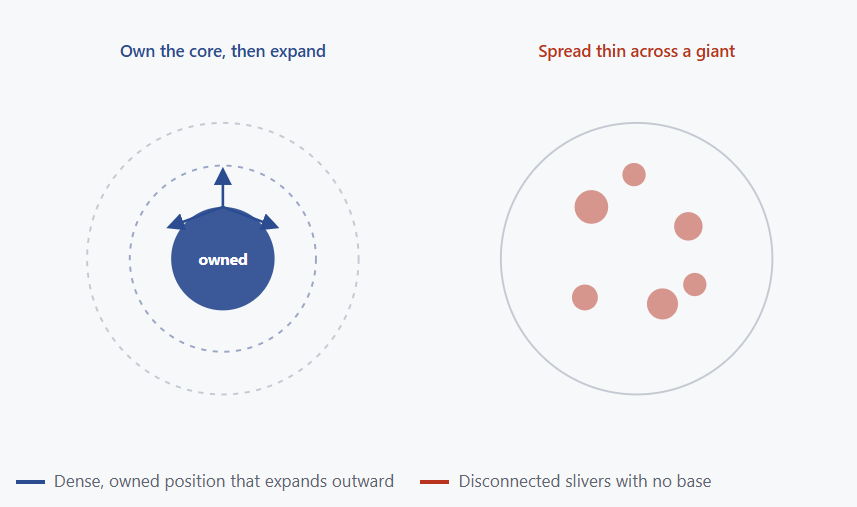
Conceptual model. Left: a fully owned core radiates into adjacent rings, each entered from strength. Right: the same effort scattered across a huge market, owning nothing and compounding nothing.
The expansion, when it comes, should follow the shape on the left — outward, one adjacent ring at a time, each new segment chosen because it borders something you already dominate. The customers in the next ring already know you by reputation. Your product already does most of what they need. You're not entering a market so much as letting it spill into yours.
The discipline is staying small longer than feels safe
None of this is hard to understand. It's hard to do, because every incentive pushes the other way. Investors want to hear a bigger story. Your best salespeople get restless inside a narrow segment. A competitor announces a move into a market you've been eyeing, and the fear of being boxed in pushes you to broaden before you're ready. The discipline isn't intellectual. It's the willingness to look unambitious for longer than is comfortable.
What this means for leaders
Pick a market you can actually finish. Define the beachhead narrowly enough that total ownership is realistic within a couple of years, and resist every temptation to widen the definition just to make the slide more impressive. The smallness is the strategy, not a limitation of it.
Measure share, not just growth. Revenue can rise while your position stays weak. Track the percentage of your chosen segment that uses you, and don't let yourself believe you've won until that number is uncomfortably high. Thirty percent and growing is not won; it's contested.
Expand from density, never from restlessness. When the urge to move into a bigger market hits, ask one question: does our next move border something we already dominate, and will those customers already know us? If the honest answer is no, you're not expanding from strength — you're starting over, and trading the one advantage you'd earned for a fight you haven't.
The market that looks too small to bother with is usually the only one you can actually own. Own it, and the big one stops looking like a leap. It starts looking like the next ring out.
A LookatBusiness original.