


Every board now wants an "AI strategy." Most of what gets presented is a list of features and a budget — activity dressed as direction.
The slide is always titled "Our AI Strategy," and it's always the same slide. A grid of use cases. A copilot here, a chatbot there, a summarization feature bolted onto the product the customer already had. A budget line with a comfortable number. A logo wall of vendors. The room nods, the spend gets approved, and everyone leaves believing a strategic question has been answered.
Nothing has been answered. A list of places you intend to add AI is not a strategy any more than a list of places you intend to add software was one in 2002. It's a procurement plan wearing a strategist's jacket.
The theater problem
What gets presented in most boardrooms is AI theater: activity engineered to look like direction. The tell is that you could swap one company's deck for a competitor's and not notice. Same copilots, same summarizers, same "AI-powered" prefix stapled to existing features. If your AI plan is indistinguishable from everyone else's, it cannot be a source of advantage, because advantage is by definition the thing competitors don't have.
The deeper confusion is treating "we use AI" as if it were a position. It isn't, for a simple reason: the capability is commoditizing faster than almost anything in the history of enterprise technology. Frontier model performance that was a moat eighteen months ago is now a line item available to anyone with an API key and a credit card. The same models, at similar quality, are available to you and to the competitor across town on identical terms. Whatever you can buy off a price sheet, your rival can buy off the same price sheet by Friday.
"We have AI" defends nothing, because everyone has the same AI from the same handful of providers. The only strategic question is what the AI lets you do that's hard to copy and that customers actually care about.
The question worth asking
That question — durable, customer-relevant edge — is the whole game, and it has almost nothing to do with which model you license. The model is the commodity input. The strategy lives in the scarce thing the model attaches to: proprietary data nobody else holds, a distribution channel competitors can't reach, a workflow you're embedded in so deeply that switching is painful, a brand customers trust enough to let the AI act on their behalf.
AI compounds the value of those scarce assets. It does not create them. A company sitting on a decade of proprietary outcome data can build an AI feature no competitor can match, not because its model is better but because its fuel is. A company with a trusted relationship can deploy automation customers will actually permit, while a less-trusted rival shipping the identical feature gets switched off. Strip away the scarce complement and you're left with a wrapper around an API that anyone can clone in a quarter.
Visual 1 — Theater vs. strategy
AI as theater | AI as strategy | |
|---|---|---|
What drives it | The technology is available, so we add it | A scarce asset the AI makes more valuable |
Durability | None — competitors ship the same feature in a quarter | High — rivals can copy the model, not the complement |
Customer impact | A demo that impresses internally, shrugs externally | Solves a problem customers will pay and switch for |
How it's measured | Features shipped, budget deployed, "AI-powered" in the copy | Retention, pricing power, work the customer no longer does |
How to use it: run each AI initiative across the row. If it only earns the left column, you're funding theater. The right column is where a defensible edge actually sits.
The contrarian part: narrow, quiet, and late can win
Here is where the prevailing advice gets it backwards. The pressure on every leadership team is to be early and loud — to be seen moving on AI, to ship something visible this quarter, to reassure the board and the market that you're not behind. For a lot of companies, that's exactly the path that destroys value.
AI features fail in a specific and expensive way. They're probabilistic, which means they're wrong sometimes, and when a customer-facing feature is confidently wrong, it doesn't just underdeliver — it erodes trust. A support bot that invents a refund policy, a summarizer that drops the one clause that mattered, an agent that takes a wrong action on a customer's behalf: each of these spends down the most valuable asset you have, and trust is far cheaper to lose than to rebuild. Shipping an unreliable AI feature to look current can do more damage than shipping nothing.
So the right strategy for many companies is narrow and unglamorous. Pick the few places where AI attaches to something you uniquely have, get those genuinely reliable, and stay quiet about the rest. Being second with something that works beats being first with something that doesn't. The board won't applaud restraint. Restraint is frequently the correct answer anyway.
Visual 2 — Bolt-on vs. built on a scarce complement
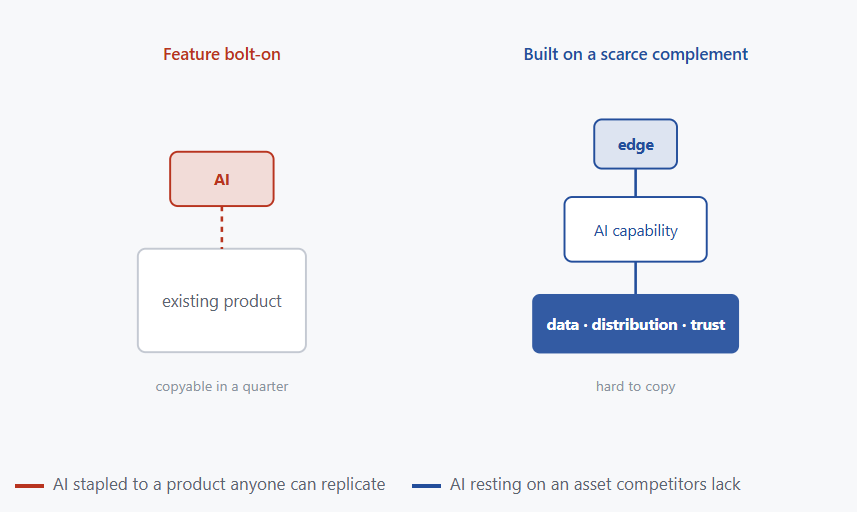
Conceptual model. Left: a feature floats on top of a generic product and travels to every competitor by next quarter. Right: the edge is the scarce foundation under the AI, not the AI itself.
Build, buy, or wait
Once you've found the place where AI rests on something scarce, the implementation question is more boring than the deck suggests. Build only where the work itself is the differentiator — where owning the system is part of the edge. Buy everywhere the capability is genuinely a commodity, because building a worse version of what you could license is a tax on engineering, not a moat. And be willing to wait where the technology isn't yet reliable enough for the stakes involved. Waiting feels like falling behind. Often it's just declining to be the one who proves the feature doesn't work yet.
What this means for leaders
Stop asking "where can we add AI" and start asking "what do we have that AI makes more valuable." The first question generates a feature list every competitor will also generate. The second points you at the data, distribution, or trust that only you hold — the only ground on which an AI advantage can actually stand.
Treat reliability as a strategic variable, not an engineering detail. A flashy feature that's wrong 8% of the time can cost you more trust than its novelty is worth. Decide which AI touchpoints are allowed to be imperfect and which must be near-flawless before they ship, and resist the pressure to launch the second kind early.
Measure the edge, not the activity. Features shipped and budget deployed are inputs that flatter a board and prove nothing. Watch whether AI is moving retention, pricing power, or the volume of work your customer no longer has to do. If none of those move after a year of spend, you didn't have a strategy. You had a slide.
A LookatBusiness original. Note: most enterprises report limited measurable ROI from AI to date, even as adoption and spend continue to climb.