


Companies pay a premium for what makes a target special, then systematically dismantle it in the name of integration. The deal logic and the integration logic are at war.
Eighteen months after a deal closes, you can usually tell what happened by watching who's left. The founder is gone or visibly checked out. The scrappy product team that shipped weekly now waits on a quarterly planning cycle. The thing the acquirer chased — that strange, fast, beloved little company — has been folded into the org chart and quietly ceased to exist. The logo survives. The substance evaporated.
This is not an unlucky outcome. It is the modal one. Decades of studies put the share of acquisitions that fail to create value somewhere between half and three-quarters, and the most common cause isn't overpaying at signing. It's what the buyer does after.
The premium paradox
Start with the strange thing buyers do at the negotiating table. They pay a premium — often 30%, sometimes far more — and that premium is explicitly a price for difference. Nobody pays up for a company that does exactly what they already do. You pay up because the target moves faster, attracts talent you can't recruit, holds a culture you can't replicate, or owns a relationship with customers you've never been able to win.
Then the integration plan arrives, and its entire purpose is to make the target more like the parent. Same systems, same approval chains, same compensation bands, same brand, same cadence. The acquirer has paid a premium for difference and immediately set about manufacturing sameness. The deal logic and the integration logic point in opposite directions, and integration almost always wins, because it's run by people whose job is consistency, not preservation.
You pay a premium for the ways a company is unlike you, then spend the next two years engineering away every one of them. The check rewards difference; the integration plan punishes it.
How integration kills it
The destruction is rarely dramatic. No one decides to ruin the thing they bought. It dies by a hundred reasonable decisions, each defensible on its own.
The talented people leave because their equity vested, their autonomy didn't survive, and a slower, larger company is simply less fun to work at. The product slows because it now routes through the parent's release process, its security review, its legal sign-off. The speed that justified the premium was never a feature; it was a property of a small team that could decide things in a hallway, and that property does not survive contact with a 4,000-person process. Customers who loved the target for not being the giant now find they've been quietly handed to the giant.
Visual 1 — Bought it, broke it, or kept it
The asset | What you actually bought | What integration tends to destroy | What to protect |
|---|---|---|---|
Talent | Founders and key builders who can't be hired any other way | They vest, lose autonomy, and walk | Mandate, ownership, a reason to stay past the earn-out |
Speed | A team that decides in hours, not quarters | Release cycles, reviews, and sign-offs slow it to the parent's pace | Decision rights and a separate operating cadence |
Culture | Norms that produced the work you envied | Absorbed into the parent's defaults until it's gone | The boundary that lets it stay different |
Customer trust | A relationship built on not being the incumbent | Rebranded and re-platformed onto the giant | Continuity of brand, contacts, and the original promise |
How to use it: for each row, write down what would have to be true a year out for the asset to survive. If your integration plan makes any of column four impossible, you're planning to destroy what you paid for.
The synergy myth
Synergies are the number that justifies the premium to the board. Combine the back offices, consolidate the platforms, cross-sell to the bigger base, and the model spits out a figure large enough to make the math work. The figure is real on the spreadsheet. The problem is that the same actions that produce cost synergies are frequently the actions that destroy the revenue you bought.
Consolidate the platform and you break the product the customers chose. Move the target onto the parent's sales force and the deals that closed because of the founder's reputation stop closing. Merge the teams to capture efficiency and the people who made the thing valuable update their résumés. The synergy is not the mechanism of value creation here. It is, more often than anyone admits, the mechanism of destruction — value transferred from the column that mattered to the column that's easier to measure.
That's the turn worth sitting with: the integrations that actually work tend to integrate the least. The buyers who preserve value are the ones who treat the acquired company as something to wall off and feed, not something to absorb. They give it capital, distribution, and air cover, and they keep the parent's processes on the other side of a clear line. They forgo most of the synergies on the slide, and they keep the asset alive.
When to integrate, when to leave alone
The decision isn't binary, and it isn't a matter of taste. It follows from one question: what did you actually buy? If you bought a capability that's stronger inside your machine — a technology that's better with your scale, a product line that genuinely belongs in your suite — integrate it, and do it fast and cleanly. Half-integration is its own disease.
But if you bought a culture, a velocity, a brand, or a set of people whose value depends on the environment that produced them, the right move is restraint. Leave the brand. Leave the office. Leave the decision rights. Give the founder a real mandate and a budget and a wide berth, and measure them on outcomes rather than process compliance. The instinct to "capture the synergies" is the instinct to kill the patient to harvest the organs.
Visual 2 — Value of the acquired asset after close
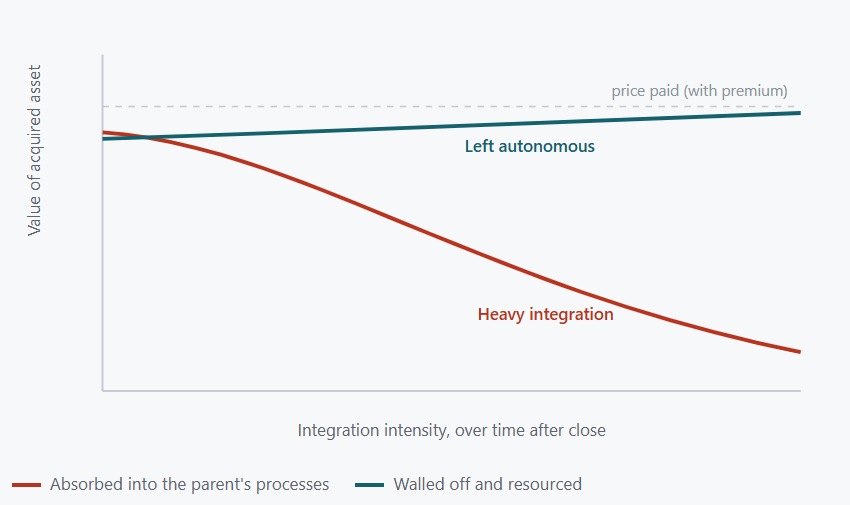
Conceptual model. The dashed line is what you paid. The more aggressively you integrate a difference-based asset, the faster its value falls below the price — while the version you leave alone at least holds the line.
The human reality
There's a fact every deal model treats as a footnote and every failed integration treats as a surprise: the asset can walk. A factory can't quit. A patent doesn't get a better offer. But the people you spent the premium on can decide, on any given Tuesday, that this isn't what they signed up for, and leave. When the value of an acquisition lives in human judgment and relationships, you didn't buy an asset. You leased one, and the lease renews monthly on terms you don't fully control.
What this means for leaders
Name the thing you're buying before you sign. Write down, in one sentence, the specific source of value the premium is paying for. If that sentence describes people, speed, or culture, your integration plan is the biggest risk in the deal, not the financing. Build the plan around protecting that sentence.
Treat synergies as a hypothesis, not a promise. Every synergy on the slide is also a candidate cause of death. Before you green-light one, ask what it might break on the revenue side. The cost saving is certain; the revenue it endangers is the thing you actually paid for.
If you can't leave it alone, reconsider buying it. Some organizations are structurally incapable of restraint — every acquisition gets absorbed because that's how the machine works. If that's you, and the target's value depends on staying different, the honest move is to not do the deal. You'll pay a premium for something you're guaranteed to destroy. Better to admit that before the wire transfer than to discover it eighteen months later, watching the last of the team you bought clean out their desks.
A LookatBusiness original.