


"We're better than the competition" is the most common strategy claim and the weakest. Better is a treadmill; different is a position.
Sit in enough strategy reviews and you start to hear the same sentence, lightly reworded each time. We're faster. We're more reliable. We have better support, a better roadmap, a better team. The slide changes; the claim doesn't. Whatever the category, the company's plan for winning is to be a superior version of everyone else.
It sounds like confidence. It's usually a confession that there is no strategy at all.
"Better" feels safe because it's true often enough to be defensible in a room. Your product probably is a little faster, your team probably is a little sharper. But notice what that claim quietly agrees to: it accepts the competitor's definition of the contest. You've decided to run their race, on their track, and merely to run it harder. That's not a position. It's a treadmill with a brand on it.
Why better invites the very fight you'll lose
The trouble with being better is that it's a comparative claim, and comparative claims summon comparison. The moment your pitch is "we do the same thing, only superior," you've handed the buyer a checklist and invited them to score you against everyone else line by line. Sometimes you win the checklist. The problem is that the checklist itself is the enemy.
Whatever margin of "better" you build, a competent rival can close. Features get copied within a quarter or two. Speed advantages erode as the rest of the field tools up. The reliability gap that felt like a moat in 2024 is table stakes by 2026. Being better at the same thing is, almost by definition, a temporary condition, because the thing you're better at is legible to everyone who wants to imitate it.
And when several companies are all "better" at the same shared dimension, the buyer can no longer tell them apart on substance, so they fall back on the one axis that always separates near-identical options: price. The reward for winning the better race is a commodity market and a margin that shrinks every renewal. You competed your way into a knife fight.
Visual 1 — Better vs. Different
Dimension | Competing on "better" | Competing on "different" |
|---|---|---|
Basis of competition | The same axis as everyone else, run harder | An axis you chose because rivals can't easily follow |
Copyability | High — a legible edge invites imitation | Low — built on trade-offs rivals won't make |
Pricing power | Erodes toward the commodity floor | Holds, because there's no clean substitute |
How the customer chooses | Feature checklist, then price | "This is the one for people like me" |
What it shows: the two postures across the dimensions that decide durability. The insight: "better" loses on every row that matters over time, because each advantage it builds is one a competitor can copy and then discount.
Different is a decision, not a degree
Different works precisely because it refuses comparison. When you're meaningfully unlike the alternatives, the buyer can't run a clean side-by-side, because there's no apples-to-apples to run. You're not a superior entry in their consideration set. You're a different question they have to decide whether to answer.
This is the move that the strongest companies make and the rest avoid. They don't try to be the best CRM, the best agency, the best chip. They become the obvious choice for a specific kind of customer with a specific need that the generalists serve badly. The category leaders rarely won by being marginally superior at the incumbent's game. They changed what the game rewarded, and left everyone else optimizing a contest that no longer paid.
Here's the turn most leadership teams resist: aiming to be "the best" is often the trap, not the goal. Best is a ranking inside someone else's category. Accepting it means accepting their axis of merit, their definition of good, their frame for what buyers should weigh. The companies that actually pull away don't win the existing game. They make a different one and invite the market into it.
Being the best means agreeing to be measured on your rival's terms. The companies that win don't beat the comparison. They make themselves uncomparable.
The courage to be worse on purpose
Different has a cost that better doesn't, which is why it's rarer. To be genuinely distinct, you have to be willing to be worse at some things — to underserve customers a generalist would chase, to drop features a checklist demands, to disappoint a segment in order to be unmissable to another. Distinctiveness is built out of the trade-offs your competitors won't make, and a trade-off you're not willing to make isn't a trade-off. It's a wish.
This is where "better" thinking sabotages you. The instinct to be superior everywhere produces a product that is balanced, complete, and forgettable — strong on every axis and owned by none. The distinctive company looks unbalanced on paper. It's conspicuously light in places, because it poured everything into the one dimension where it intends to be unlike anyone else. That asymmetry isn't a flaw to fix. It's the strategy, visible.
Visual 2 — The better race vs. the different move (conceptual model)
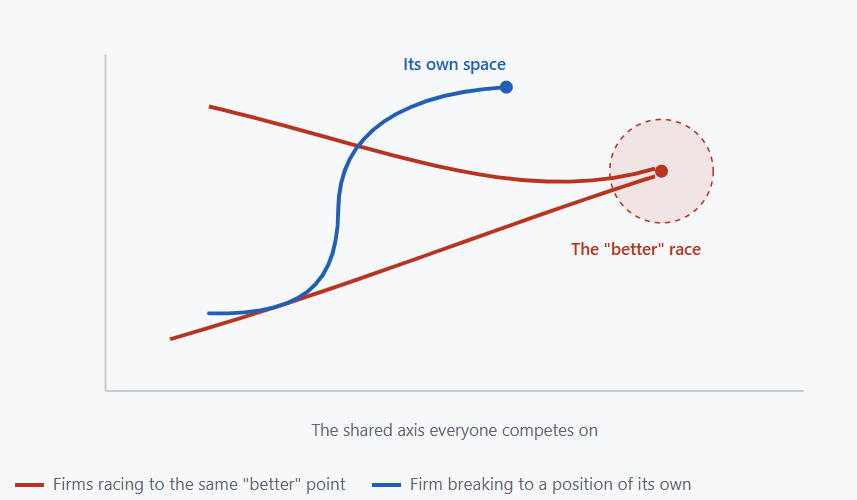
What it shows: two rivals converging on the same crowded point as each gets "better," while a third firm leaves the axis entirely. The insight: at the convergence point, buyers can't tell anyone apart and choose on price. The firm that left isn't winning the race — it's no longer in it.
How customers actually choose
The checklist is a story buyers tell after the fact, to justify a decision they mostly made on a different basis. Watch how real purchases happen and you'll see it: people don't buy the product that scored highest across forty rows. They buy the one that feels made for their situation, the one a trusted peer already uses, the one whose pitch made them think this company actually understands my problem. Fit beats features. Identity beats specs.
That's terrible news for "better" and wonderful news for "different." You cannot be the obvious fit for everyone — fit is specific by nature. But you can be the unmistakable choice for a particular buyer, and that buyer won't run the checklist at all, because you've already answered the only question on it: is this for me? Different isn't a louder version of better. It's a decision to be the answer to a narrower question, and to mean it.
What this means for leaders
Audit your strategy for the word "better." Read your own deck and underline every claim that's a comparative — faster, cheaper, more reliable, best-in-class. Each one is a place where you've agreed to run a rival's race. If the underlines outnumber the genuine differences, you don't have a strategy yet. You have an aspiration to win someone else's.
Name the trade-off you're willing to make. Distinctiveness is purchased with deliberate weakness. If you can't say what you've chosen to be worse at, you haven't chosen to be different — you've chosen to be balanced, which the market reads as interchangeable. The question to put to your team isn't "where are we ahead?" It's "what are we willing to be bad at so we can be the only ones at something?"
Stop chasing best; choose unlike. Best is a position inside someone else's category, and the prize for winning it is a price war. Unlike is a category of your own, defended by trade-offs your rivals won't copy. Pick the customer you intend to be unmissable for, build the asymmetry that serves them, and let the rest of the field keep racing toward the point where everyone looks the same.
The market never rewarded the company that did the same thing slightly better. It rewards the one that made the comparison impossible.
A LookatBusiness original.