


For a generation, labor was the input you could always get more of. That assumption is quietly expiring, and most strategies still treat people as abundant.
A retail operator I know spent the spring rebuilding her store-opening model. Same format, same unit economics, same playbook that had carried the chain for fifteen years. The one line that wouldn't behave was staffing. Not the wage line — she'd budgeted for that. The problem was finding the bodies at all. In three of her growth markets, the candidates simply weren't there at any price she could clear and still make the box work.
That is not a hiring problem. It's a preview.
For most of the careers of everyone now running a company, labor sat in the background as the one input you never had to think too hard about. Capital had a cost. Real estate had a cost. Energy had a cost. But people — people you could always get more of. Post a job, raise the wage a notch, widen the radius, and the supply showed up. Demand for workers was the constraint that mattered; supply was assumed to be effectively infinite. Every growth model built in the last thirty years quietly encodes that assumption, whether or not anyone wrote it down.
The assumption is expiring. Not cyclically. Structurally.
The squeeze is demographic, and demographics don't bounce
Here is the number that should be on a slide in every boardroom and is on almost none of them. By 2026, US labor-force growth is projected to slow to fewer than 10,000 net new workers a month — a record low for a peacetime economy. For comparison, a healthy expansion used to add ten or twenty times that. The river of new workers that fed every staffing plan since the 1980s is narrowing to a trickle.
Stretch the horizon and it gets starker. Hold labor-force participation where it is and let demographics run, and BLS projections imply roughly 4.3 million fewer workers by 2034 than if participation had stayed steady. Three forces are pulling in the same direction at once. The boomer cohort is retiring in volume, and it is large. The generations replacing them are smaller, so fewer young entrants arrive each year to backfill. And reduced immigration removes the one lever that historically papered over a domestic shortfall.
The reason this matters more than a soft jobs report is that it doesn't reverse with the business cycle. A recession can slacken demand for workers for a year or two. It cannot manufacture twenty-five-year-olds who were never born. The people who will be entering the workforce in 2034 are alive today; you can count them. There is no policy, no rate cut, no hiring campaign that conjures a cohort into existence on a strategic planning horizon.
Visual 1 — Labor-force growth, flattening
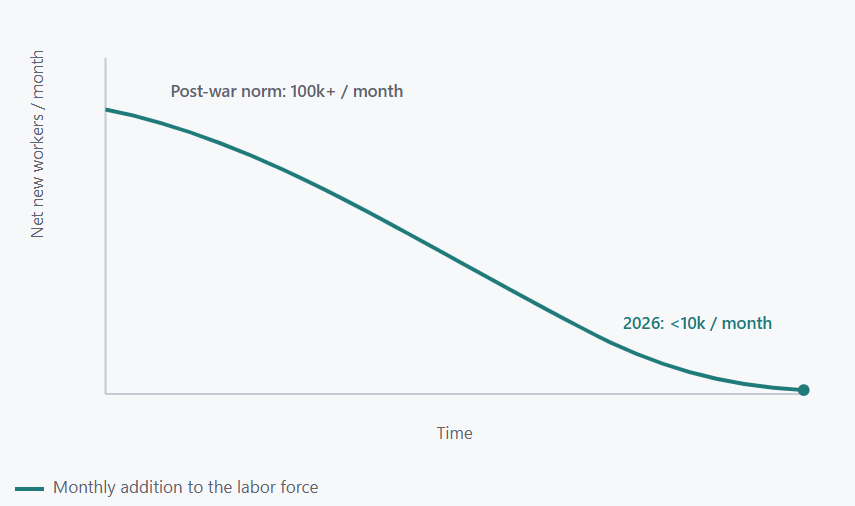
Illustrative. Curve is stylized to show the trajectory; the endpoint reflects the under-10,000-per-month figure projected for 2026. The shape is the point: a line approaching the floor, not dipping and recovering.
Why recruiting harder solves nothing
The instinct, when staffing gets tight, is to recruit better. Sharper job ads, faster pipelines, a more compelling employer brand, a referral bonus. All of it is sensible, and none of it touches the actual problem.
Recruiting is competition over a pool. It determines which firms get which share of available workers. It does nothing about the size of the pool itself. When the pool is shrinking, "recruit harder" is a strategy for winning a larger slice of a smaller pie — which is to say, it works for the few companies that execute it best and necessarily fails, in aggregate, for everyone else. You cannot recruit your way out of a shortage that is system-wide. Someone has to lose, and most of the market is "someone."
This is the reframe most leadership teams haven't made. Tight labor reads as an HR challenge: a function to resource, a problem for the people team to own. It is not. It is an input-scarcity problem, and input scarcity lands on strategy, not on HR. When a core input to your business model becomes permanently scarcer and dearer, the question is no longer "how do we recruit better." It's "does this model still work at the new price of its main ingredient."
What quietly gets repriced
When an abundant input turns scarce, its price doesn't just rise. The whole calculus stacked on top of it shifts.
Wages move first and most visibly, and they don't give the gains back when the next downturn arrives, because the scarcity underneath them is structural. Automation ROI recalculates next: every dollar of permanently higher labor cost lowers the bar a machine or a model has to clear to pay for itself. Projects that didn't pencil out at last decade's wages quietly cross into positive territory. And labor-intensive growth models — the ones whose scaling story is fundamentally "open more locations, add more headcount, repeat" — face the hardest math, because the thing they need more of is precisely the thing the economy is producing less of.
That last point is the contrarian one, so let me say it plainly. The shrinking workforce is not chiefly an HR problem to be managed with better recruiting. It is a structural change in the price and availability of a core input — and it silently changes which business models are viable at all. A growth strategy that compounds by adding people is, in a labor-scarce economy, a strategy that compounds by buying more of the input that's getting scarcer and more expensive every year. That model isn't failing loudly. It's becoming unviable quietly, one unfillable role at a time.
Labor wasn't cheap because it was abundant. It looked abundant because the demographics were generous. Those demographics have turned, and the companies that confused a tailwind for a law of nature are about to learn the difference.
Cheap cognition meets scarce labor
The timing here is not a coincidence so much as a collision. At the precise moment human labor is becoming structurally scarcer, machine cognition is becoming structurally cheaper. One curve goes up as the other goes down, and they cross.
For a decade, the case for automation was mostly about speed and consistency, and it competed against labor that was plentiful and, by today's standard, cheap. That comparison has inverted. Automation is no longer pitched against an abundant input; it's pitched against a scarce and rising one. When the alternative to the machine is a worker you can't find at a wage you can afford, the machine wins arguments it used to lose. The AI buildout and the demographic squeeze are usually discussed as separate stories. They are the same story from two ends.
Visual 2 — Old assumption vs. new reality
Decision | Old assumption: labor is abundant | New reality: labor is scarce |
|---|---|---|
Wages | A cyclical line that softens in downturns | A structurally rising floor that doesn't retreat |
Automation | Nice-to-have; competes against cheap labor | Core strategy; competes against labor you can't hire |
Growth model | Scale by adding headcount and locations | Scale by adding output per worker |
Location | Expand where the market is | Expand where the workers still are |
How to read it: any strategy still living in the middle column is pricing a core input wrong. The right column is not a forecast of bad times — it's the baseline for the next decade.
Who wins and who loses
The winners will be the firms whose growth doesn't depend on adding workers in proportion to revenue — the high output-per-head models, the ones that genuinely treat automation as the spine of the operation rather than a press release. They will compete for a smaller pool of workers, but they'll need fewer of them per dollar earned, and that ratio is the whole game.
The losers will be the businesses whose entire scaling logic assumes a deep, cheap labor pool that no longer exists: the expansion stories that pencil only at yesterday's wages and yesterday's fill rates. Many of them will not see it as a strategic problem until it's a survival one, because the symptom shows up as a hundred small operational frustrations rather than one legible threat on a slide.
What this means for leaders
Treat labor as a priced input, not a given. Put it on the same footing as capital and energy in your models — a cost that moves, that can be scarce, that constrains where and how fast you can grow. If your strategy assumes you can always staff the plan, write down that assumption and then ask whether it's still true in your specific markets. For a growing number of them, it isn't.
Pressure-test the growth model, not just the recruiting funnel. The right question isn't "how do we hire faster." It's "does our model still work if the workers we need keep getting scarcer and dearer for ten straight years." If the honest answer is no, recruiting improvements are a tourniquet, not a cure. The fix is upstream, in how the business creates value per person.
Move on automation before the math forces you to. The firms that invest in output-per-worker while it's still optional will compound an advantage over those that wait until the labor shortage makes it mandatory. By the time it's obvious, the cost of catching up is highest and the talent to build it is scarcest.
The workforce is shrinking. It will keep shrinking on a schedule you can already read in a population table. The strategies that win the next decade won't be the ones that recruited hardest. They'll be the ones that stopped assuming the people would always be there — and built accordingly while their competitors were still posting jobs.
Sources: Indeed Hiring Lab, "Demographic Squeeze: Why Labor Force Participation Is Projected to Fall Through 2034"; Economic Policy Institute, "The U.S.-born labor force will shrink over the next decade"; and Federal Reserve Bank of Kansas City, "Declining Immigration and an Aging Population Are Reducing Breakeven Employment Growth."