

The bottleneck on AI was supposed to be silicon. It's turning out to be electricity — and the company that can't get power can't compete, no matter how many chips it can buy.
The most valuable thing in an AI data center deal right now isn't the GPU allocation. It's the interconnection agreement — the piece of paper that says the local utility will actually deliver the megawatts. You can have a signed order for tens of thousands of accelerators and a balance sheet to pay for them, and still be unable to switch the building on, because the power isn't there and won't be for years. Operators have started walking sites not by their fiber or their chip supply but by how close they sit to a substation with spare capacity.
For two years the story everyone told about AI's limits was a story about chips. Whoever secured the most silicon would win; the constraint was fab capacity and allocation. That story was true, briefly. It has been overtaken.
The binding constraint on AI's expansion is shifting from GPUs to electricity. Not the cost of power, though that's rising — the raw availability of it, plus the grid capacity to move it and the equipment to step it down. The gating factor on the buildout is no longer how many chips you can buy. It's whether you can get power to them on a timeline measured in years, not quarters.
The scale of the demand
The figures have moved out of the realm of incremental and into the realm of national. Gartner projects worldwide data-center power demand rising about 27% in 2026, to roughly 132 gigawatts, up from around 104 gigawatts in 2025. That is not a percentage you tack onto an existing grid plan; it's a step change inside a single year. The IEA puts 2026 data-center electricity consumption near 1,000 terawatt-hours — comparable to the entire annual consumption of Japan. We are, in effect, wiring up a new industrial nation's worth of demand and asking the existing grid to absorb it.
And the load is concentrating in the hungriest form. AI-optimized servers are projected to draw about 31% of total data-center power in 2026 — a slice that barely existed a few years ago, now approaching a third of the whole. This isn't general digital growth lifting all boats evenly. It's a specific, dense, fast-arriving load showing up faster than anything the power system was built to handle.
Visual 1 — Data-center power demand steps up
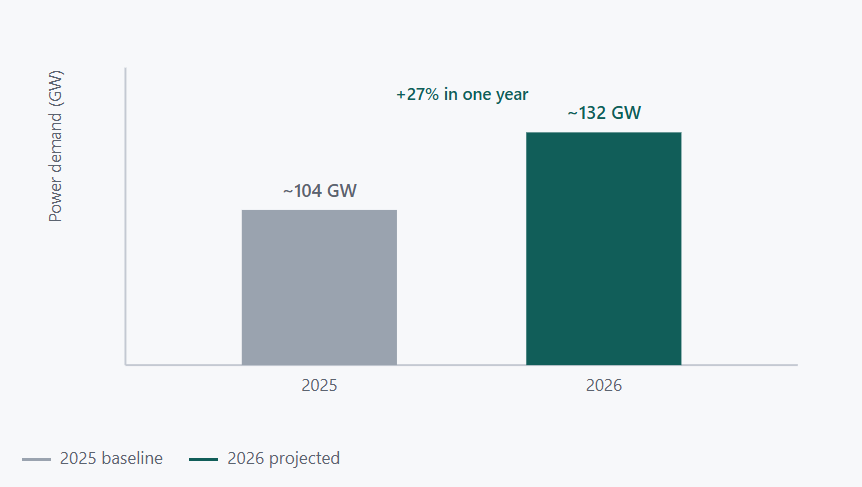
Illustrative. Bars are stylized; the values reflect Gartner's projection of roughly 104 GW in 2025 rising to about 132 GW in 2026. A 27% jump in twelve months is a load the grid was never planned to take.
Why power can't scale on AI's clock
Here is the brutal asymmetry at the center of this. Compute scales on a software clock. Power scales on an infrastructure clock. They are not the same clock, and they are not close.
You can train a frontier model in months and deploy it globally in days. You cannot build a high-voltage transmission line in months — it takes years, through permitting, easements, and construction. You cannot conjure a substation on demand. And the single quietest bottleneck of all: transformer lead times now run two to four years. A transformer is an unglamorous lump of copper and steel, and right now it is one of the hardest things in the AI economy to obtain. Order one today and it may arrive after the model it was meant to serve is already obsolete. Permitting, grid interconnection queues, and the physical supply chain for heavy electrical equipment all move on timelines that have nothing to do with how fast a model improves.
This is why "just build more" doesn't dissolve the constraint. The thing in short supply isn't ambition or capital. It's the multi-year physical process of getting electricity to a location, and that process has a floor you cannot buy your way under.
Building around the grid, and its new problems
The industry's response has been to route around the public grid — behind-the-meter generation, on-site gas, deals with nuclear plants, dedicated power purchase agreements that lock up supply for years. Sensible moves, each one. But they generate their own frictions. The concentrated new load is reshaping wholesale power markets in ways that ripple past the data center. In the PJM territory, the largest US grid region, data-center demand has been cited as roughly doubling regional capacity costs — meaning the load lands not only on the operators chasing it but on every household and business sharing that grid. Power has become the defining constraint on data-center growth, and increasingly a public, political one rather than a private engineering footnote.
The race nobody named
This is where the conventional framing has it backwards, and the error is worth naming directly.
The AI race was sold as a software race, won by the most "AI-native" players. It's quietly becoming an energy and infrastructure race — and that advantages the incumbents with power access, land, and grid relationships over the pure software shops the original story crowned.
Sit with how thoroughly that inverts the expected order. The AI-native narrative said the edge belonged to the nimble software-first companies unencumbered by physical assets. But when the binding constraint becomes electricity, the asset-heavy incumbents look very different. The utility with spare capacity and the grid relationships. The industrial operator sitting on permitted land near transmission. The energy company that can build generation. The hyperscaler whose real moat turns out to be the substations it locked up years ago. The constraint rewards exactly the kind of slow, physical, capital-intensive position that the software-first story treated as a liability. Whoever controls power controls the pace, and power is not a thing you disrupt with a clever model.
Visual 2 — Assumed constraint vs. real constraint
Dimension | Assumed constraint: chips | Real constraint: power |
|---|---|---|
Scarce resource | GPU allocation, fab capacity | Electricity, grid capacity, transformers |
Lead time | Quarters; scales on a software clock | Years; transformers alone run 2–4 years |
Who it advantages | Capital-rich, software-first players | Energy & infrastructure incumbents with grid access |
How you solve it | Buy more chips | Build power — and wait for permits and steel |
How to read it: the left column was last year's race. The right column is this year's, and it favors a different kind of company entirely.
Who gets squeezed
The squeeze falls hardest on the players with capital and chips but no power position — the firms that assumed electricity was a utility bill, a line item, rather than the gating input it has become. They will find themselves with idle accelerators and no megawatts to feed them, outbid for grid capacity by operators who started locking it up years earlier. Strategy decks built around model quality and chip supply quietly missed the variable that now sets the ceiling.
The advantaged are the ones who treated power as primary: the operators co-locating with generation, the incumbents converting grid relationships into a moat, the few who read the constraint early and bought their way into power before the rest of the market understood it was the prize.
What this means for leaders
Treat power as a strategic input, not a facilities concern. If your AI roadmap assumes electricity simply shows up when the chips arrive, that assumption is now the riskiest line in the plan. Put power availability on the same page as compute and capital, because it constrains both. The company that secures megawatts is buying the right to use the chips it already ordered.
Reread the competitive map through an infrastructure lens. The threats and the allies look different once power is the constraint. An energy company or industrial incumbent you'd never have listed as an AI competitor may control the input that decides who scales. Partnerships with utilities and power developers are becoming as strategic as partnerships with chipmakers.
Plan on the infrastructure clock, not the software clock. Compute timelines lie to you about how fast you can grow, because the limiting timeline is the grid's, and the grid moves in years. Build that lag into the strategy now. The firms that started securing power eighteen months early will be running while the ones who waited are still in an interconnection queue.
The AI economy was supposed to be won in silicon and software. It's increasingly being decided in substations and supply chains for heavy electrical equipment. The most important question for the next phase isn't whose model is best or who has the most chips. It's a far more old-fashioned one: who can get the power.
Sources: Gartner, "Data Center Electricity Demand to Grow in 2026" (press release); Bloom Energy, 2026 Data Center Power Report; and Brookings, "Global energy demands within the AI regulatory landscape."