

Everyone can feel AI working. Almost no one can find it in the productivity statistics. That gap is the most important economic question of the year.
Ask a knowledge worker whether AI has changed their job and you'll get an emphatic yes. The draft that took an hour now takes ten minutes. The research that ate an afternoon happens before lunch. Survey after survey says the same: people feel faster, and they aren't lying.
Now look at the macroeconomic data, where all that speed is supposed to surface as productivity growth. It mostly isn't there. As Apollo's Torsten Slok put it, "AI is everywhere except in the incoming macroeconomic data." Everyone can feel the tool working. Almost no one can find it in the numbers. That gap — between felt productivity and measured productivity — is the most important economic puzzle of the year.
We have seen this movie
The economists reaching for the right frame keep landing on the same one. In 1987, Robert Solow quipped that "you can see the computer age everywhere but in the productivity statistics." Computers were transforming every office, and the aggregate data refused to show it. The line became famous because the paradox it named took the better part of a decade to resolve — and then it did, dramatically, once firms reorganized around the new tools rather than simply bolting them onto old workflows.
That history is the most useful thing we have for reading the present. The lesson of the Solow paradox was never that the technology didn't work. It was that the gains showed up on a lag, gated not by the hardware but by the slow, unglamorous work of redesigning how organizations operate. The machines were ready years before the companies were.
Visual 1 — Perceived vs. measured
| What people report | What the data shows |
|---|---|---|
Time saved | BCG: 42% report ~8 hours/week saved | Macro productivity barely moves |
Financial payoff | Adoption is broad and growing fast | PwC: 56% saw neither revenue gains nor cost cuts; only 12% saw both |
The felt experience | "This has changed how I work" | "AI is everywhere except in the data" — Slok |
Best explanation | Not a technology failure — an organizational-design and training lag. Gains require redesigning work, which trails adoption by years. | |
How to read it: the time savings are real and individual; the measured payoff is collective and missing. The bottom row is where most serious analysts now land.
Saved hours that vanish
Look closely at what the felt gains actually are, and the puzzle starts to resolve. BCG found that 42% of workers report saving roughly eight hours a week. That's an enormous amount of recovered time. So where does it go?
Mostly, it dissipates. Saved hours get absorbed into more meetings, more polish, more output that nobody needed, or simply slack that never converts into anything the income statement records. An individual feels faster; the organization runs at the same speed, because the time freed up was never redirected into something that compounds. Eight hours saved by one person, scattered across a team with unchanged processes, nets to roughly zero in the aggregate. That is the arithmetic of the paradox, and it has very little to do with how good the model is.
The uncomfortable finding
Here is the turn that should rearrange how you think about your own AI program. The companies capturing real, measurable gains are not the ones using the most AI. They're the ones that changed how they work around it.
Tool adoption without redesign produces activity, not productivity. The firms seeing returns didn't deploy more AI than everyone else — they rebuilt the process the AI sits inside. The rest bought the same tools and kept the same workflow, and got faster individuals inside an unchanged machine.
This cuts directly against the instinct driving most corporate AI strategy, which measures progress in seats deployed, queries run, and tools rolled out. Those are adoption metrics, and adoption is not the variable that pays. The analysts looking hardest at this — including in central-bank research — increasingly frame the shortfall as an organizational-design and training failure, not a technology one. The bottleneck isn't the model. It's the org chart, the workflow, and the willingness to rebuild both.
Visual 2 — The widening gap
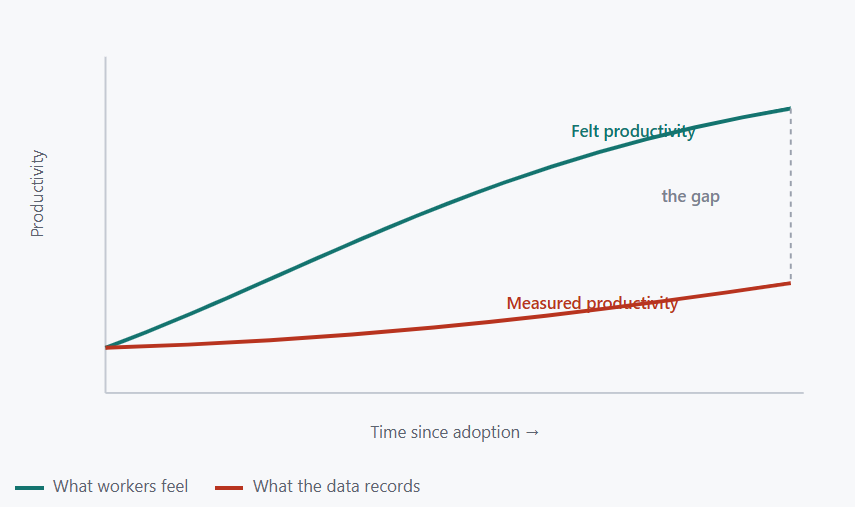
Illustrative. Felt productivity jumps with the tool; measured productivity trails because the gains require process redesign to surface. The gap is the lag — or, if the redesign never comes, a mirage.
Lag or mirage
Two readings of the gap lead to very different futures, and the difference is not academic. If this is a lag — the Solow pattern repeating — then the gains are real and coming, and the companies doing the hard organizational work now will pull away as the data catches up. Forecasts already expect productivity to improve through 2026, led by high-skill services and finance, which is consistent with a lag beginning to close.
If it's a mirage, the felt savings never convert because they can't, and a great deal of capital has been spent making individuals feel faster while changing nothing that shows up in output. The honest answer is that we don't yet know which it is. But the evidence leans toward lag — because the mechanism that closes the gap, organizational redesign, is exactly the slow, deliberate work that hasn't happened yet at most companies. The gains aren't missing. They're un-built.
What this means for leaders
Stop measuring adoption and start measuring redesign. Seats deployed and queries run tell you nothing about whether you're capturing value. The question that matters is which processes you have actually rebuilt around AI — and if the honest answer is "none, we just gave everyone the tool," you've bought activity, not productivity.
Chase the freed-up hours or lose them. Time saved that isn't deliberately redirected evaporates into slack and polish. Decide in advance where recovered capacity goes — into more output, fewer people on a task, faster cycles — or it will net to zero exactly as it has across the macro data.
Treat this as an organizational-design problem, not an IT rollout. The companies pulling ahead aren't the heaviest AI users; they're the ones who changed how work flows. That's leadership work, not procurement. If your AI program lives entirely in the tooling budget, you've located it in the wrong department.
The tech works — that part is settled. Whether it shows up in your numbers depends on something the model can't do for you: the unglamorous, deliberate rebuilding of how your organization actually works. The firms that do it will find the gains were never missing. They were waiting on a decision their competitors haven't made yet.
Context drawn from: Fortune, "The AI productivity paradox" (CEO study, Robert Solow), PwC, "2026 Global CEO Survey", and Federal Reserve Bank of Atlanta, "Artificial Intelligence, Productivity, and the Workforce: Evidence from Corporate Executives."