


Layoffs are judged by how they treat the people who leave. They're survived or not based on how they treat the people who stay.
The room goes quiet in a particular way after a layoff. Not the relief of a hard thing finished, but a held breath. The people who kept their jobs are still at their desks, and they are watching everything: the tone of the all-hands, the awkwardness of the manager who an hour ago shook a colleague's hand for the last time, whether anyone says the word "fired" or hides behind "transition." They are not grieving the people who left, or not only. They are quietly recalculating their own odds, and yours.
Most leaders prepare for the wrong audience. They rehearse for the people being let go, scripting the conversation, the severance, the calendar. That work matters and it's the part the law and the press care about. But the people leaving are, by the next morning, gone. The people who remain are the company. And they will decide, in the weeks after, how hard to work for you, how much to trust the next thing you say, and whether to start taking recruiter calls.
A layoff is usually managed as a one-time cost event. A line item, a charge, a quarter you absorb and move past. That framing is where the damage hides. The cost that doesn't show up on the restructuring slide is the slow withdrawal of the people you most needed to keep.
The bill you don't see on the slide
The arithmetic of a cut is seductive because it's clean. Remove a number of roles, save a number of dollars, and the model balances. What the model never prices is discretionary effort — the gap between the work people are contractually obligated to do and the work they actually do when they believe in where things are going.
After a badly run layoff, that gap widens fast. People do their jobs and not one thing more. They stop volunteering for the unglamorous fix, stop staying late on the launch, stop covering for a teammate. None of it appears in any system. It shows up as projects that slip, quality that erodes, and a strange new sluggishness that nobody can quite trace to a cause.
Then the second bill arrives, and it's the expensive one. Your strongest remaining people — the ones with the cleanest résumés and the most options — are precisely the ones a botched cut sends to the market. They can read a process. A vague, drawn-out, dishonest layoff tells them everything about how this place behaves under pressure, and they conclude, reasonably, that they'd rather not be here for the next one.
The cruelty of a botched layoff isn't only an ethical failure. It's a commercial one. Treat people badly on the way out and the bill is paid by the best people who stay — the ones who have somewhere else to go.
That's the contrarian part most cost-cutters miss. The humane way to run a layoff and the smart way are the same way. Dignity isn't a luxury you grant when you can afford it. It's retention insurance for the people you can least afford to lose.
Visual 1 — Two ways to cut
Dimension | Botched layoff | Layoff done well |
|---|---|---|
Communication | Euphemism and silence; people learn from rumor or a deactivated badge | Plain words, named publicly, leaders accountable for the decision |
Pace | Drawn out over weeks; rolling cuts that keep everyone braced | Decided, executed, and closed in days, then explained fully |
Who's told what | Different stories to different rooms; survivors left to guess | One honest account of why, the same for those leaving and staying |
Survivor trust | Collapses; people assume they're next and start interviewing | Bruised but intact; people believe the worst is named and over |
Outcome | Quiet attrition of your strongest people over the next two quarters | A smaller team that still pulls hard because it still believes you |
How to read it: the columns share a goal — fewer roles, lower cost. They differ only in execution, and the execution is what determines whether the survivors stay engaged or start leaving.
Speed is mercy, and slowness is the cruelty
Leaders who fear seeming heartless often default to a slow process, believing that deliberation reads as care. It reads as dread. A layoff stretched across weeks — rumors, then a "review of the organization," then a town hall that confirms nothing, then a second round — turns the whole company into a waiting room. Nobody works. Everybody refreshes the news. Your best performers polish their stories because the silence has told them this place can't be trusted to be straight with them.
Decide once. Cut once. Do it deep enough that you don't have to come back, because a second round after you promised there wouldn't be one does more damage than the first cut and the slow build combined. Then end the suspense and start rebuilding the same day. The cruelty people remember isn't the severance figure. It's the eight weeks they spent unable to plan their own lives because you couldn't bring yourself to say the thing you'd already decided.
Honesty about why, even when it's unflattering
There is always a real reason, and survivors can usually guess it. Demand softened. A bet didn't pay off. The company hired ahead of revenue that never came. The instinct is to dress this up — "realigning to strategic priorities" — but euphemism insults the intelligence of exactly the people you need to keep believing you.
Name the cause plainly, including the part that's on leadership. "We grew the team for a level of growth that didn't materialize, and that's a planning failure that sits with me, not with the people leaving." That sentence is expensive to say and it buys something nothing else can: the survivors learn that you'll tell them the truth even when it costs you. Every future hard message lands better because of it.
Dignity is operational, not sentimental
Protecting the dignity of people who leave isn't a PR posture, and the survivors are the proof. They watch how their departing colleagues are treated and read it as a forecast of how they'll be treated someday. Generous severance, real notice where you can give it, references that mean something, leaders who run the hard conversations themselves instead of outsourcing them to a script and a video call — these are signals aimed as much at the people staying as the people going.
Cut the corners here and you save a little cash and teach your whole company that loyalty is a one-way street. That lesson, once learned, is very hard to unteach.
What this means for leaders
Plan the survivor experience as carefully as the exit. Most layoff playbooks end at the moment people are told. Yours should start a second playbook there — what you'll say the next morning, the week after, the month after, to the people still in their seats. They are the company you're trying to save, and right now they're deciding whether to stay.
Move fast and tell the truth, in that order. Decide once, cut deep enough to mean it, and explain the real reason — including your own part in it — the same day. Speed limits the dread; honesty limits the cynicism. Drag it out or dress it up and you'll pay for both in the resignations that follow.
Owe the survivors a credible plan, not a pep talk. People who just watched colleagues leave don't want reassurance that everything's fine. They want to know what the smaller company is for, why it can win now, and what their part in it is. Give them a believable path and your strongest people have a reason to stay. Give them optimism with no plan behind it and you've confirmed their decision to go.
Visual 2 — What happens to the people who stay
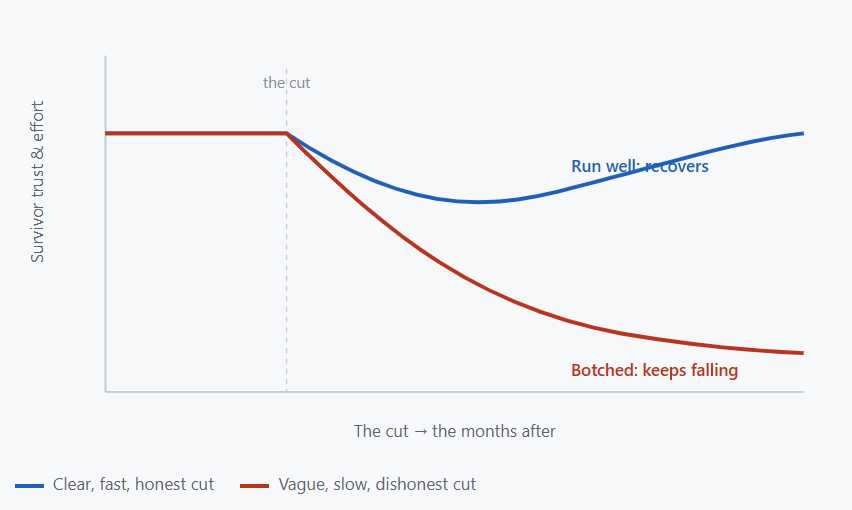
Conceptual model. Both lines fall at the moment of the cut — that's unavoidable. The difference is the slope afterward: a well-run process lets trust recover, while a botched one keeps bleeding it, often through the resignations of the people you most needed to keep.
A layoff is a wound either way; no version of it feels good, and it shouldn't. But there's a wide gap between a wound that heals and one that festers, and the difference is almost entirely in your hands. Cut because you must. Cut once, cut straight, and cut with the people staying clearly in view. The company you keep is the only one that matters now, and it's still watching.
A LookatBusiness original.