


A leader whose team can't make good calls in their absence hasn't built an organization. They've built a dependency with their name on it.
You go on holiday and the messages start on day two. A pricing exception that needs your sign-off. A customer escalation parked until you weigh in. A hiring decision that's been ready for a week and is waiting on your read. By day four you're answering Slack from a beach, and a quiet voice in your head says the thing you've trained yourself to hear as a compliment: they really need me. Look closer. That voice is describing a failure, and it has your name on it.
We measure leaders by the quality of their decisions. It's the wrong test. The decisions you make are visible, satisfying, and ultimately a poor proxy for whether you've built anything that lasts. The real test is the one you never see, because by definition it happens when you're not there: the quality of the calls your people make when you're out of the room. That number — not your own judgment — is the actual output of your leadership.
By that measure, an enormous amount of senior leadership is quietly failing. The org runs beautifully when the leader is present and seizes up the moment they step away. That's not a strong leader. That's a bottleneck that's learned to feel like a strength.
The dependency trap, and why it feels so good
Every consequential decision routing through one person is a trap that springs slowly. It starts reasonably — you're the most experienced, your judgment is genuinely best, so people bring you the hard calls. You make them well. They learn that you make them well. So they bring you more, and stop developing the muscle to make them alone, and the routing hardens into a habit nobody chose but everyone now depends on.
The reason it persists is that it feels wonderful. Being the person everything runs through is a steady drip of significance. Every escalation confirms your importance. Every "let me check with you first" tells you that you matter, that the place can't function without you. Hoarding judgment doesn't feel like hoarding. It feels like being needed, and being needed is a powerful thing to give up.
But the organization you've built is fragile in a specific, dangerous way. It has a single point of failure, and the point is you. You can't take a real vacation, can't go deep on the few things only you can do, can't be sick or distracted or hit by the proverbial bus, without the whole system stalling. You've optimized for your own centrality and called it leadership.
Visual 1 — Two kinds of leader
Dimension | Leader as bottleneck | Leader as multiplier |
|---|---|---|
Decision speed | Capped at one person's calendar; everything queues | Parallel; calls happen where the information is |
Scale | Limited to what one mind can personally hold | Grows with the number of capable decision-makers |
Fragility | Single point of failure; absence halts the system | Resilient; runs cleanly when the leader is away |
Growth of people | Stunted; reports stay executors, never judges | Compounding; people build judgment by exercising it |
What it optimizes for | The leader's own indispensability | The organization's capacity to decide |
How to read it: the left column often looks like strength from the inside — busy, central, needed. The right column looks, from the inside, almost like you're not doing much. The second one is the job.
Teaching the call, not making it
The fix is not delegation, or not only. Handing someone a task — "you own the vendor selection" — moves the work. It doesn't move the judgment. They can execute the decision you'd have made and still come back helpless the moment a genuinely new call appears, because what transferred was the chore, not the thinking behind it.
Developing judgment is a different and slower act. It means letting people make the call while you're still there to catch the fall — and resisting the overwhelming urge to make it for them. When someone brings you a decision, the lazy move is to decide. The developmental move is to ask: what would you do, and why? Then, most of the time, to let them do it, even when you'd have chosen differently and the difference doesn't much matter.
That last part is where most leaders quietly cheat. They say they're developing people while reserving every real decision for themselves, granting authority over the trivial and pulling it back the instant the stakes rise. People aren't fooled. They learn that the authority is theatre, and they stop trying to think because thinking changes nothing.
Being indispensable is a failure state, not an achievement. The leader everything depends on hasn't built strength into the organization — they've extracted it, and stored it in the one place that can walk out the door.
The conditions for good independent calls
People can't make good decisions without you simply because you've decided to let them. They need three things you're responsible for providing, and most bottleneck leaders provide none of them.
The first is context — the why behind the strategy, the constraints that aren't written down, the history of what's been tried. People who only get tasks make narrow decisions; people who understand the whole picture make calls you'd be proud of. The second is principles — not a rulebook for every case, which is impossible, but the handful of priorities that let someone reason their way to a sound answer in a situation you never anticipated. The third is safety: the genuine, demonstrated freedom to make an imperfect call and not be punished for it. The first time you publicly second-guess a reasonable decision that happened not to land, you've taught everyone watching to route the next one back to you.
Tolerating the imperfect call
Here's the cost nobody wants to pay. Building decision-makers means living with decisions that aren't the ones you'd have made, and some of them will be worse. A person learning to decide will get a few wrong — that's not a bug in the system, it's the tuition. The leader who can't stomach a suboptimal call from a report will, without ever intending to, pull every real decision back into their own hands and wonder why nobody around them ever grows.
The discipline is to distinguish a bad outcome from a bad decision. A sound call can land badly; a sloppy one can get lucky. Coach the reasoning, not the result. If you punish good decisions that happened to fail, you teach people to stop deciding. If you reward bad decisions that happened to work, you teach them to gamble. Either way the judgment you were trying to build never forms.
Visual 2 — Where decisions go
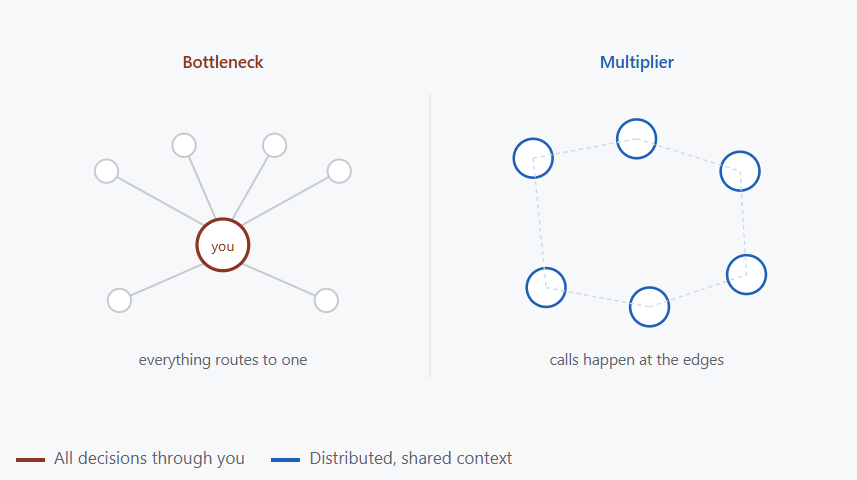
Conceptual model. On the left, every decision converges on a single node — fast to feel important, slow to actually move, and dead when that node is away. On the right, calls are made where the information lives, held together by shared context rather than a chokepoint. One scales. The other just gets busier.
What this means for leaders
Treat your own indispensability as a warning, not a trophy. The pull of being needed is real and it's pointing you the wrong way. If the honest answer to "what happens here when I'm gone for two weeks?" is "things stall," you've built a dependency, and dismantling it is now the most important work you have.
Coach the reasoning, not the result. When someone brings you a call, ask what they'd do and why before you say a word. When their decision lands badly but the thinking was sound, defend it. When it lands well but the thinking was lazy, name it. The judgment you build this way is worth more than any single decision you'd have made yourself.
Give real authority and let imperfect calls stand. Authority you yank back at the first stumble isn't authority — it's a test people learn to fail safely by not trying. Hand over decisions that actually matter, provide the context and principles to make them well, and then live with the ones that don't go your way. That tolerance is the price of an organization that can run without you, which is the only kind worth building.
The leader who can step away for a month and return to find good decisions made in their absence has built something real. The one who returns to a backlog of calls that waited for them has built a monument to their own importance — impressive, central, and quietly doomed the day they leave. Your job was never to be the smartest person in the room. It was to fill the room with people who don't need you in it.
A LookatBusiness original.