


You recruited an impressive executive, and a year later it isn't working. The instinct is to blame the hire. The cause is more often the company that brought them in and left them to sink.
Eleven months in, the VP you fought to hire is on the way out. You spent six months courting her, beat two other offers, told the board she was the catch of the year. The references were glowing. The interviews were sharp. And somewhere around month nine the meetings started to feel heavy, her ideas kept stalling in committee, and the team that was supposed to rally around her closed quietly around her instead. Now you're drafting the separation and telling yourself you misjudged her.
You probably didn't. Senior external hires fail at uncomfortably high rates — a large share don't make it past their second year — and the reflex is always to fault the person. Wrong read on their character, oversold in the interview, not as good as the résumé. Sometimes that's true. Far more often, the hire was perfectly capable and the company that recruited her never set her up to succeed. You bought a thoroughbred and forgot to build a track.
This is a different problem from inheriting a team you didn't choose. That's about you walking into an existing group and earning their trust. This is the mirror image: someone you chose, walking into your organization, and the question is whether you integrated them or simply imported them and hoped.
What actually kills them
Senior hires rarely fail at the work. They fail at everything around the work — and the things around the work are the things only the company can provide.
The first is an unclear mandate. The hire was brought in to "fix marketing" or "fix the product org," a charge broad enough to mean anything and therefore nothing. Without a sharp definition of what success looks like in twelve months, the new executive spends their first quarter guessing at the real assignment while everyone watches them guess.
The second is no political capital. A senior leader's authority on paper is worthless until someone with existing standing publicly spends their own credibility to back them. When the CEO hires a star and then steps away to "let them run," the org reads the distance as ambivalence and treats the newcomer as optional. Every initiative now has to be won from a standing start, against people who've banked years of trust.
The third is the organizational immune system. Every established team has antibodies. The new senior person arrives with different methods, a different vocabulary, sometimes a different read on what's broken — and the existing system recognizes them as foreign and moves, often unconsciously, to expel them. Meetings get scheduled without them. Decisions route around them. None of it is announced. All of it is felt.
Visual 1 — The blame gap
The story we tell | What actually happened |
|---|---|
"They weren't as good as the résumé." | They were exactly as good, but no one defined what good would look like here. |
"They couldn't build relationships." | No one with standing lent them theirs; they networked from zero against insiders. |
"They moved too slow." | Their mandate was a slogan, so they spent a quarter decoding the real assignment. |
"The team never accepted them." | The org's immune system rejected them, and leadership did nothing to override it. |
"Bad cultural fit." | No one translated the culture; they were left to learn the unwritten rules by failing. |
How to use it: when a senior hire is failing, read the right column before the left. If three of these describe your situation, you have an onboarding problem wearing the mask of a hiring mistake.
The trap that catches the best ones
Here's the part that runs against instinct. The more impressive the hire, the more likely the organization is to abandon them — and the more likely they are to fail because of it.
A junior hire gets a structured onboarding, a buddy, a thirty-day check-in. A celebrated senior executive gets a handshake and a corner office, because everyone assumes that someone this accomplished obviously doesn't need help. Seniority gets mistaken for self-sufficiency. "They ran a thousand-person org, they'll figure out a status meeting" sounds reasonable and is exactly backwards. The bigger the reputation, the further the fall the org assumes can't happen, and the less anyone does to prevent it.
"They're senior, they'll figure it out" is the most expensive sentence in talent. The more you pay for someone, the more an organization convinces itself they need nothing — and the more quietly it lets them drown.
Impressive people are not immune to a hostile system. They're often more exposed to it, because their arrival is more threatening to the incumbents and their pride makes them slower to ask for the help no one offered.
The ninety days you owe them
The first ninety days aren't the hire's to figure out alone. They're a setup the company is responsible for building, and the work starts before day one.
Define the mandate in writing, in outcomes, not territory. Not "own product" but "ship the platform rebuild and rebuild trust with the three accounts we nearly lost." Spend your own capital visibly — not a welcome email, but you in the room saying "she has my full backing and her calls are my calls," and then actually deferring to those calls when they're tested. Pre-warn the immune system: tell the existing team why this person is here, what changes, and that resisting them is resisting you.
And assign someone to translate the culture — the unwritten rules, the people who really decide things, the meeting that looks ceremonial but isn't. None of this is babysitting. It's the difference between integration and abandonment, and it costs a fraction of the search you'll run again if you skip it.
Visual 2 — Two onboarding paths over the first year
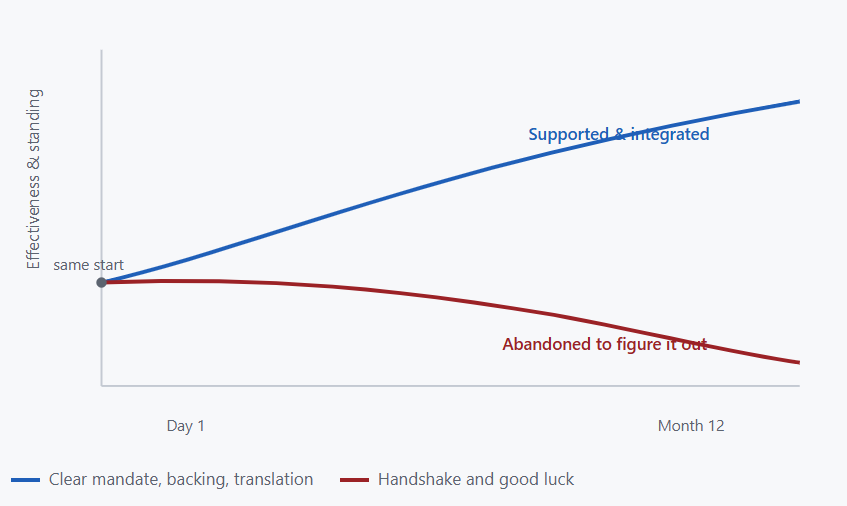
Conceptual model. Same person, same start. The path is set in the first quarter by what the company does — not by who the hire is. Most "bad hires" are the lower line wearing the explanation of the wrong cause.
Telling a bad hire from a bad onboarding
The distinction matters because the fixes are opposite. A genuinely bad hire shows trouble in the work itself — flawed judgment on the actual decisions, a skills gap the interviews missed, values that surface as a problem under pressure. A bad onboarding shows trouble around the work — a capable person whose good ideas keep dying in the system, who can't get traction not because they're wrong but because the org won't carry them.
If you can't get a straight answer, run the test: would this person have thrived somewhere that set them up properly? If yes, the failure is yours, and replacing them just resets the same trap for the next victim.
What this means for leaders
Treat onboarding a senior hire as your project, not theirs. The instinct to "let them run" is abdication dressed as respect. The first ninety days are an organizational task — mandate, backing, translation — and the owner is you. Skip it and you'll pay for the search twice.
Spend your capital loudly and early. A senior hire's authority is borrowed from yours until they've banked their own. Stand visibly behind them, defer to their calls in public, and tell the existing team that resisting the newcomer is resisting you. Silent backing reads as no backing.
Diagnose before you replace. Before you conclude you misjudged someone, audit what the organization did and didn't do. If the honest answer is "not much," you don't have a hiring problem — you have a system that eats good people, and the next impressive hire will meet the same fate.
The talent market punishes the obvious failure — the bad hire — and quietly forgives the hidden one — the company that wastes a good one. Stop blaming the people you chose and start auditing what you did with them after they said yes. The catch of the year is only a catch if you build a place where they can actually land.
A LookatBusiness original. Scenarios described are composites and do not depict specific individuals or companies.