


Most of the hardest leadership happens sideways — across peers, functions, and partners you can't command. Title-based authority runs out exactly where the important work begins.
The launch is slipping because engineering, marketing, and legal each have a reason it should slip, and not one of them works for you. You can see the whole thing — the dependency that nobody owns, the decision stuck between two VPs who are each waiting for the other to move. And you have exactly zero ability to issue an order that fixes it. You can ask. You can escalate, which means asking someone above you to ask. What you can't do is the one thing your title seems to promise: tell people what to do and watch them do it.
This is where most real work lives now, and most leadership training never goes there. The whole apparatus — the org chart, the management courses, the language of "direct reports" — assumes a clean line from you down to the people who execute. But the consequential work increasingly runs across that line, not down it. The product needs four functions to cooperate. The deal needs a partner you don't employ. The transformation needs a peer who has their own priorities and their own boss. Authority points down. The work points sideways.
So the skill that separates leaders who scale from leaders who stall isn't commanding the people who report to them. It's moving the people who don't.
Where the chain of command quietly ended
Organizations got matrixed while everyone kept drawing the same pyramid. Functions deepened, work got more interdependent, and the result is that almost nothing important can be delivered by one chain of command acting alone. A product manager with no direct reports is accountable for an outcome that requires engineers, designers, marketers, and a finance partner — none of whom they can direct. We built whole roles around influence and then handed the people in them a title that implies authority they don't have.
Command fails sideways in a specific, predictable way. Order a peer's team to do something and you don't get compliance — you get a turf dispute, an escalation, and a colleague who now files you under "people to slow down." Formal authority is a currency that only spends downward. Carry it into a peer relationship and it's not just useless. It's actively counterproductive, because the attempt to use it tells everyone you don't understand how this works.
Visual 1 — Two directions of leadership
Dimension | Leading down (authority) | Leading sideways (influence) |
|---|---|---|
What moves people | Position; you can ultimately direct and decide | Trust, reciprocity, shared goals, and your credibility |
Speed | Fast in the moment — say it, it happens | Slower to build, but durable once the relationship holds |
When command is used | Sometimes necessary; the backstop exists | Backfires — reads as overreach, triggers resistance |
What fails it | Over-reliance breeds compliance without commitment | Transactional relationships with no prior deposits of goodwill |
Where it's tested | Inside your own function and reporting line | Across peers, functions, and partners you can't command |
How to read it: the left column is the leadership most people are trained for. The right column is where the largest, most cross-cutting outcomes actually get decided — and where the tools from the left column don't fit the locks.
The currencies that actually move people
Strip away the title and a different economy appears. People who don't report to you act on your behalf for reasons that have nothing to do with your level: because they trust you to do what you say, because you've helped them before and they'd like the relationship to continue, because they genuinely share the goal, or because your judgment has earned the right to be heard.
Trust is the base currency. A peer who believes you'll follow through, won't surprise them in front of their boss, and will share credit honestly will move mountains for you that no escalation could. Reciprocity is the engine — you helped them ship last quarter, so they'll find the capacity for you now. Shared goals are the alignment: when you can frame your request as their win, you're not asking for a favor, you're handing them one. And credibility is what makes your ask worth saying yes to in the first place, because your track record says you're usually right about what matters.
The reversal nobody trains for
Here's what runs against the instinct. Reaching for your authority is a sign of weak leadership, not strong. The leaders who can only move the people they outrank are the ones who seize up the moment they hit a peer — and the bigger the job, the more of the work is peers.
Authority is the tool you reach for when you've run out of influence. The leaders who scale almost never need it sideways, because they built the relationships before the launch was on fire — when there was nothing yet to ask for.
This is why command is a tell. The executive who escalates every cross-functional friction, who can't get a peer to move without invoking a boss, has revealed the ceiling on their range. They function inside their own pyramid and stall everywhere else. The ones who keep rising are the ones whose colleagues say yes before the title is ever mentioned, because the title was never the reason.
Visual 2 — Where the real work crosses
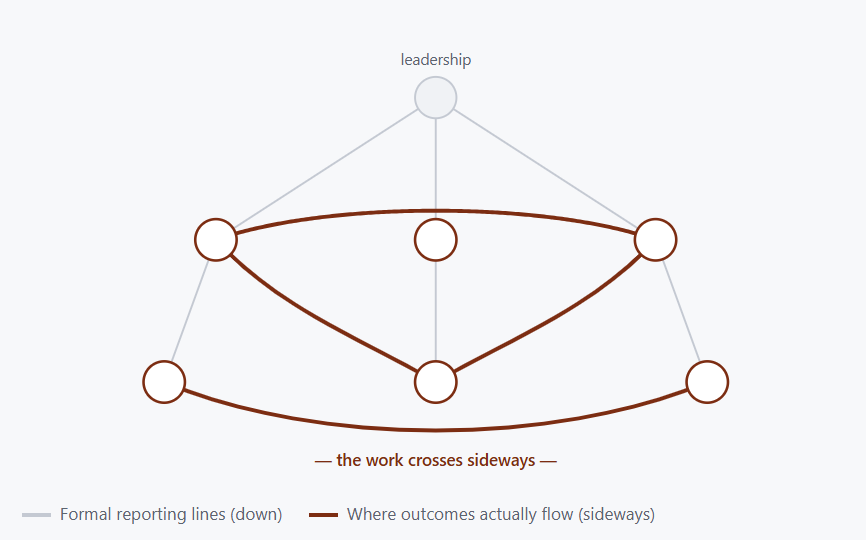
Conceptual model. The faint vertical lines are the org chart. The bold lines are how a real launch, deal, or transformation actually moves — between peers and functions, not up and down a chain. The chart tells you who reports to whom; it tells you almost nothing about how the work gets done.
Build the bridge before you need to cross it
Influence is not a thing you deploy in a crisis. It's a thing you have, or don't, when the crisis arrives — and the only time to build it is before. The leader who shows up at a peer's door for the first time with an urgent ask is negotiating from zero. The one who spent the prior six months being useful, reliable, and generous with credit is calling in a relationship that already exists.
That means the unglamorous, ongoing work of being someone other people want to help: keeping your word on small things, offering help that doesn't immediately benefit you, understanding what your peers are measured on and making them look good against it. Each of those is a deposit. The launch on fire is the withdrawal. You can only take out what you put in, and the time to put it in is when nothing is on the line.
What this means for leaders
Audit how often you escalate. Frequent escalation of cross-functional friction isn't diligence — it's the sound of influence you never built. If you can't move a peer without invoking your boss, you've found the edge of your range, and it's narrower than your title suggests.
Make deposits before you need withdrawals. The relationships that deliver your biggest outcomes are built in the quiet months, not the crisis weeks. Be useful to your peers when there's nothing in it for you. That's not nicety — it's the only thing in your account when the launch slips.
Promote for sideways range, not just downward control. Plenty of leaders run their own function well and stall the moment they're handed something cross-cutting. When you're deciding who scales, watch how peers respond to them, not how their reports do. The ones whose colleagues say yes before the title comes up are the ones who'll handle the bigger, messier mandates.
The org chart is a map of who can be ordered. It is a terrible map of how work actually happens, and the gap between the two is exactly where leadership now lives. The leaders who matter learned to navigate without the map — moving people they couldn't command, toward outcomes no single chain of command could deliver. That's not a softer kind of leadership. It's the harder kind, and increasingly it's the only kind that scales.
A LookatBusiness original.