


Founders guard their idea like treasure and fear someone stealing it. The market's actual response to most ideas isn't theft — it's indifference. Execution and distribution are the scarce parts.
A founder once asked me to sign an NDA before he'd describe his startup. I signed it, he leaned in, lowered his voice, and told me his idea. It was a good idea. It was also, almost exactly, two other companies I'd read about that month and one I'd passed in the airport that morning. He thought he was handing me a secret. He was handing me a category.
This is the most common misallocation of energy in early-stage company building: founders treat the idea as the precious, fragile, steal-able asset, and arrange everything around protecting it. The protecting is the mistake. The market almost never wants to take your idea. It wants to ignore it.
Indifference, not theft, is the default response to a new idea. And indifference is a far more useful problem to have, because it points you at the thing that actually matters and the secrecy reflex actively hides.
The idea-as-treasure myth
The myth runs deep because it flatters us. The idea is the part that came from you — the shower-thought, the insight nobody else had, the spark. It feels like the irreplaceable contribution, so it's natural to assume it's the valuable one.
It almost never is. Walk into any coworking space and you'll find a dozen people sitting on "the next big thing in X." Scroll any pitch event and the ideas blur together, because good ideas cluster — the same market conditions that made yours obvious to you made it obvious to a hundred other smart people at the same time. The idea isn't scarce. The conditions that produce it are public.
What's scarce is everything that comes after: the willingness to build the unglamorous version, the channel that gets it in front of buyers, the thousand unsexy decisions that turn a sentence into a business. Those don't show up in the pitch, which is exactly why founders underweight them.
Visual 1 — What founders overvalue vs. what actually matters
Founders obsess over | The market rewards | Why the second one is scarce |
|---|---|---|
The idea | Execution — shipping a real, usable version | Everyone has ideas; almost no one finishes |
Secrecy | Feedback — early contact with real buyers | Secrecy costs you the input that improves the thing |
Being first to think of it | Distribution — a repeatable way to reach demand | First doesn't matter; reachable does |
Protecting the concept | A team that can build and sell it | The concept is copyable; the team isn't |
How to read it: the left column is where most early energy goes. The middle column is where the value actually accrues. The gap between them is the cost of guarding the wrong asset.
The secrecy tax
Secrecy isn't free. It charges a tax, and the tax is paid in the one currency early founders can't afford to lose: feedback.
Every week you spend hiding the idea is a week you don't spend showing it to the people who'd tell you what's wrong with it. The prospect who'd have said "I'd never pay for that, but I'd pay double for the thing next to it" never gets the chance. The competitor you fear copying you might actually have warned you off a dead end. By keeping the idea quiet to protect a near-zero downside, you forfeit the corrective input that would have made the idea worth protecting in the first place.
The feedback you lose by hiding an idea costs far more than the near-zero risk that someone competent drops everything to copy it. Secrecy doesn't protect a good idea. It just slows down the only process that could turn it into one.
That's the contrarian turn, and it cuts against every instinct the NDA culture has trained into founders. The math is simply lopsided. The probability that a capable person abandons their own roadmap to chase your unproven concept is small, and even if they do, they inherit the same brutal execution problem you have. Meanwhile the cost of staying quiet is certain and compounding: slower learning, later contact with the market, more time building the wrong thing in confident silence.
Why the real moats are boring
If the idea were the moat, every category would be won by whoever thought of it first. They almost never are. Search wasn't invented by Google. The smartphone wasn't invented by Apple. Social networking had a graveyard of predecessors. In each case the winner showed up with a better-executed, better-distributed version of an idea that was already in the water.
Execution is a moat because finishing is rare. The distance between a working demo and a product people rely on is enormous, and most teams quit somewhere in the middle. Crossing that distance is a durable advantage precisely because so few do.
Distribution is a moat because attention is the actual scarce resource. A worse product with a real channel beats a better product nobody can find. The boring machinery of getting in front of buyers, repeatably, is harder to copy than any feature.
Neither of these can be lifted from you in a coffee chat. That's the quiet irony: the parts of your business actually worth protecting are the parts you couldn't give away if you tried.
Visual 2 — Same idea, two teams
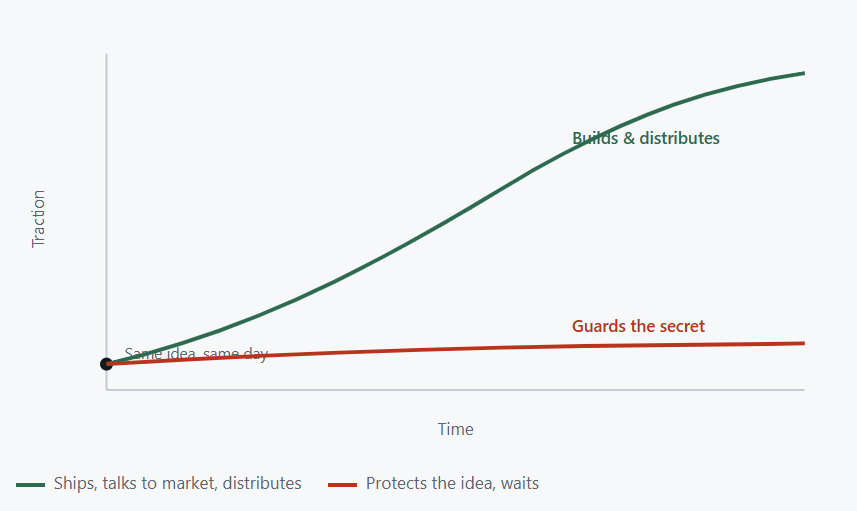
Conceptual model. Two teams hold the identical idea at the same moment. One spends its energy building and getting in front of buyers; the other spends it staying quiet. The idea was never the variable. What they did with it was.
What actually makes an idea valuable
An idea acquires value the moment it's attached to people who can ship it and sell it. Before that, it's a sentence. Investors who've seen a thousand pitches don't bet on the sentence — they bet on the evidence that this particular team will be the one out of fifty that actually crosses the execution gap and finds a channel.
So the question isn't "is my idea good enough to protect?" It's "have I shown it to enough of the market to know what's actually wrong with it, and am I the team that can build the corrected version?" Talking to buyers early isn't a risk to manage. It's the work.
What this means for founders
Spend your paranoia where it pays. Worry less about who might hear the idea and more about whether you can build and distribute it faster than the indifference of the market can outlast you. The competitor isn't another founder with your slide deck. It's apathy, and you beat apathy by shipping, not by hiding.
Trade secrecy for feedback as fast as you can. Every conversation with a real prospect is worth more than the imagined safety of silence. Show the thing. Watch where people lean in and where they glaze over. The idea you protect into oblivion is worth exactly nothing; the one you expose and correct is worth something real.
Build the team that makes the idea uncopyable. Anyone can take your concept. No one can take a group that finishes hard things and knows how to reach the buyer. Invest there. That's the asset diligence respects, the moat competitors can't lift, and the part of the business that was actually yours to begin with.
The treasure was never the idea. It was always the boring, expensive, exposed work of making it real — the part you were tempted to hide, sitting in plain sight the whole time.
A LookatBusiness original. Examples are composite illustrations of common early-stage patterns and are not drawn from any single company.