


In the early days, the founder is the best salesperson in the company, and it isn't close. The trap is believing that stays true one hire later than it should.
A prospect was forty minutes into a demo, arms crossed, clearly looking for a reason to leave. Then the founder leaned in and said, "Honestly, here's the part of our product I'd be skeptical of if I were you." The arms uncrossed. Twenty minutes later they were negotiating terms. No trained rep would have said that line, and no playbook would have told them to.
That moment is the whole argument for founder-led sales, and also the whole problem with it.
In the first year or two, the founder closes deals nobody else in the building could. They carry a conviction that can't be coached, a product knowledge that goes three layers below the spec sheet, and the authority to rewrite the deal on the spot when a buyer pushes on price or scope. A salaried rep has to check with someone. The founder is the someone. That combination wins business that a more polished, more process-driven competitor loses.
So founders sell, and they sell well, and the revenue line goes up and to the right. Everything looks healthy. Which is exactly when the most dangerous belief takes hold: that this is working, so it should keep going.
Why the founder is genuinely the best rep
It's worth being honest about how real the early advantage is, because the failure mode isn't founders overrating themselves. Most of them are right.
Conviction reads as truth. A buyer can tell the difference between someone reciting value props and someone who reorganized their life around a problem. The founder isn't performing belief. They're leaking it. That's not a technique a 90-day onboarding can install.
The knowledge has no floor. When a technical buyer asks the question behind the question, the founder doesn't escalate — they answer, and then they answer the follow-up the buyer hadn't thought to ask yet. Trust compounds fast when the person across the table clearly knows more than you do about the thing you're buying.
Flexibility nobody else has. The founder can invent a pilot, bend the roadmap, or discount on instinct because they own the consequences. That improvisation closes deals that would die in a rep's approval queue.
All true. And all of it sets up the trap, because every one of these strengths is bound to a single human being who does not scale.
Visual 1 — Founder selling: asset vs. liability
The strength | Why it wins early | When it turns into a liability |
|---|---|---|
Conviction | Buyers trust belief they can't fake | The pitch only lands when the founder is in the room |
Deep product knowledge | Answers the question behind the question | No one else can run a credible technical sale |
On-the-spot flexibility | Closes deals a rep couldn't approve | Every deal is bespoke; nothing is repeatable |
Founder's calendar | Senior attention on every prospect | Pipeline is capped at the hours of one person |
How to read it: the left two columns are why founder-led sales works. The right column is the same trait, one stage later, when it quietly becomes the thing holding growth down.
The ceiling you can't see from inside the deal
The math is unforgiving. A founder selling full time is, generously, two or three good conversations a day before the rest of the company stops getting run. That's a hard cap, and no amount of personal brilliance moves it. You can be the best salesperson on earth and still only be in one room at a time.
For a while the cap doesn't bite, because revenue per deal is high and the founder's win rate is enormous. Then the curve flattens, and it flattens precisely because the company succeeded. More inbound, more deals, more markets — and one calendar to absorb all of it. The thing that drove early growth becomes the thing throttling it.
The reflex is to hire a rep. The rep underperforms. The founder concludes the rep was weak and goes back to selling personally, which feels like the system self-correcting. It isn't. It's the dependency reasserting itself.
The diagnosis problem
Here's the part founders rarely admit, often because they genuinely don't know it: most can't explain why they win.
Ask a founder who closes 60% of qualified deals what they actually do, and you'll get a shrug dressed up as an answer. "I just talk to them." "I show them the thing." "They get it or they don't." The real motion — the order they surface objections in, the moment they choose to show weakness, the specific phrasing that flips a skeptic — runs on instinct they've never had to make explicit. It works, so they never decompose it.
That's fine when the founder is the only one selling. It's catastrophic the moment they try to hand it off, because you can't transfer a process nobody has written down. The first rep doesn't fail because they're bad. They fail because they were handed a job description and a quota, and the actual product — the sequence in the founder's head — never made it onto the page.
If only the founder can sell it, you don't have a sales model. You have a dependency. And a company whose revenue depends on one irreplaceable person is a company that can't truly scale and can't cleanly be sold.
That's the contrarian turn, and it stings because it reframes the founder's greatest strength as a structural risk. The brilliance that wins the early deals is also the fog that hides whether anything repeatable exists underneath. A buyer doing diligence on your company will ask the question you've been avoiding: if you took the founder out of the sales process, what would happen to revenue? If the honest answer is "it would crater," you haven't built a sales engine. You've built a very effective single point of failure.
Visual 2 — The founder ceiling vs. a built motion
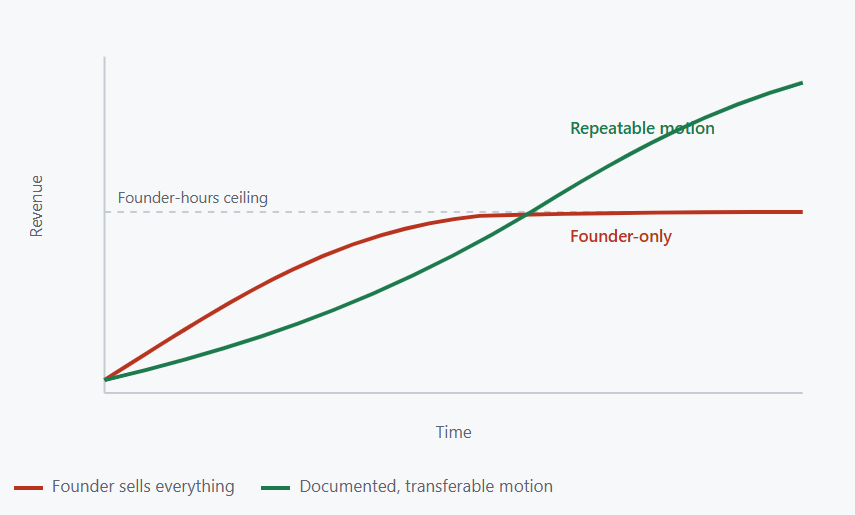
Conceptual model. Founder-led sales climbs fast, then meets the hard limit of one person's hours. A motion the founder has actually decomposed keeps climbing after they step back. The early lines look identical — the divergence is the whole point.
Handing off without losing the magic
The handoff fails when it's treated as a hire. It works when it's treated as an act of documentation that happens to involve a hire.
Before the first rep starts, the founder has to do the thing they've been avoiding: make the implicit explicit. Record your own calls and watch them like game tape. Where do you actually lose people? What objection do you defuse the same way every time? When do you deliberately admit a weakness, and why does it work? Write down the sequence, not the slogans. The goal is to turn instinct into something a second person can run, even imperfectly.
Then hire someone to sell your motion, not to invent their own — and stay in the room as a closer while they learn it, rather than vanishing the day they sign. The magic doesn't have to die in the handoff. It dies when you hand off the quota and keep the playbook in your head.
What this means for founders
Treat your win rate as a problem, not a trophy. A 60% close rate you can't explain is more fragile than a 40% one you can. The first you can't teach. The second you can scale. Start decomposing why you win while it's still going well, not after the curve has flattened.
Hire to transfer a motion, not to offload a chore. The first sales hire fails most often because the founder handed over the activity and withheld the method. Your job in that hire isn't to stop selling. It's to make yourself reproducible, which is the one thing you can't do while pretending the magic is unteachable.
Ask the diligence question early. If you vanished from every deal next quarter, what happens to revenue? Sit with the honest answer. The distance between "we'd be fine" and "we'd collapse" is the distance between a company and a very talented person with customers — and only one of those is worth what you think it is.
The founder will always be the best storyteller the company ever has. The trick isn't to keep them in every room forever. It's to get the story out of their head and into a form that travels — before the market, or a buyer, forces the question for you.
A LookatBusiness original. Scenarios described here are composite illustrations drawn from common early-stage sales patterns, not any single company.