


When a team is overloaded, the reflex is to add people. Past a point, more headcount produces less output per head — because the real cost isn't doing the work, it's coordinating it.
The team was drowning, so the VP did the obvious thing. She got approval for four more hires, onboarded them over a quarter, and waited for the backlog to clear. It didn't. Six months later the team was 40 percent larger and shipping roughly what it had shipped before — only now with more status meetings, more handoffs, and a creeping sense that everyone was busier and somehow slower. The work hadn't gotten harder. The team had gotten more expensive to run.
This is one of the most reliable mistakes in management, and it survives because it's built on a quiet assumption almost no one examines: that headcount and capacity are the same thing. Add a person, add their output. Need more done, add more people. It feels like arithmetic. It isn't.
Capacity is what a team can actually deliver. Headcount is just how many people are on it. The two track together when teams are small, then quietly diverge — and past a certain size, adding people can lower capacity, because every new person adds more coordination cost than they add productive output.
Why coordination outruns headcount
The mechanism is unglamorous and mathematical. When you add a person to a team, you don't just add a worker. You add every communication relationship between that person and everyone already there. Three people have three connections to maintain. Six people have fifteen. Twelve people have sixty-six. The headcount grew by a factor of four; the connections grew by a factor of twenty-two.
Each of those connections is real work — a Slack thread, a sync, a context-share, a decision that now needs one more person's buy-in. Output per person adds up in a straight line, but the coordination required to keep everyone aligned rises on a curve. At some crossover point the curve overtakes the line, and the next hire spends more of the team's energy than they contribute. The team feels this long before anyone names it: more meetings, more "let me loop in," more time spent deciding who decides.
Visual 1 — Communication paths explode; output per head falls
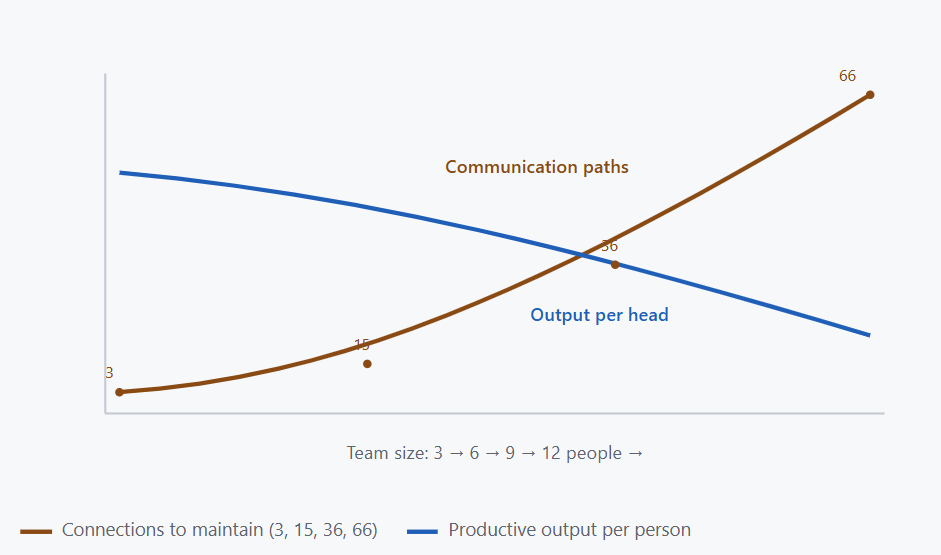
Conceptual model. The number of communication paths is n(n−1)/2 — it climbs far faster than the team. As paths multiply, each person spends more time coordinating and less producing, so output per head bends down even as headcount climbs.
The symptoms you can see from the corner office
You don't need the math to spot a team that has crossed the line. The signs are consistent. The org chart grew, but the output charts didn't. Calendars are wall-to-wall, yet people complain they can't find time to do the actual work — because the actual work has been crowded out by the work of staying coordinated. Decisions that used to take a hallway conversation now take a meeting, a follow-up, and a thread. New hires take longer to become useful, and when they do, the team's velocity barely moves.
The most telling symptom is the one leaders misread. When output stalls despite more people, the instinct is that the team still needs more people. That reads the gauge exactly backwards. The stall isn't a labor shortage. It's a coordination ceiling, and you can't hire your way through a coordination ceiling — adding people raises it.
Decision latency is the real tax
If you want a single number to watch, watch how long it takes the team to make a decision and move. That latency is where coordination cost actually shows up in the P&L, even though no line item carries its name.
Every additional person whose input is "needed," every extra approval, every stakeholder who must be aligned, adds delay between a question being asked and an answer being acted on. A team of six can decide and move in a day. The same work distributed across fourteen people, four teams, and three approvers takes three weeks — not because the work is harder, but because the decision has to travel further. Speed is a function of how few people have to agree before something can happen. More headcount, unmanaged, means more people who have to agree.
Visual 2 — Adding headcount: assumed effect vs. actual effect
Dimension | What leaders assume adding people does | What it actually does past the crossover |
|---|---|---|
Output | Rises in proportion to heads added | Rises with diminishing returns, then flattens |
Speed | Faster — more hands on the work | Slower — more people to align before anything moves |
Coordination | Roughly constant per person | Climbs combinatorially; eats the new capacity |
Ownership | Clearer — work is spread out | Murkier — more people, more "who owns this?" |
Cost per unit of output | Falls with scale | Rises as coordination overhead outpaces production |
Conceptual model. The left column is the business case that justifies the hire. The right column is what shows up two quarters later — when output is flat, the calendar is full, and nobody can say who owns the thing that's stuck.
When to add, when to subtract
None of this means hiring is wrong. Below the crossover, on genuinely parallelizable work, adding people adds real capacity and you should. The skill is knowing which situation you're in.
Add people when the work divides cleanly into independent chunks that don't require constant coordination, and when each new person can own something end to end. Be suspicious of adding people when the work is tightly interdependent, when a project is already late, or when the team's problem is alignment rather than arms. On a late project especially, the classic move makes things worse: the new people need to be brought up to speed, which pulls the people who were already productive off the work to onboard them, and the project slows down precisely when you were trying to speed it up.
The honest fix for an overloaded, tangled team is usually fewer people with clearer ownership — not more people with blurrier ownership. Subtraction is the unpopular answer that actually works.
That's the contrarian turn most leaders can't bring themselves to make, because removing people from a struggling effort feels like abandoning it. But a smaller team with sharp ownership and short decision paths routinely out-ships a larger one drowning in coordination. The constraint was never the number of hands. It was the number of conversations required before any of those hands could move.
What this means for leaders
Stop using headcount as a proxy for capacity. When a team asks for more people, the first question isn't "can we afford the hire?" It's "is this team's problem actually a shortage of labor, or a coordination ceiling that more labor will only raise?" Diagnose the bottleneck before you fund the obvious fix. Half the time the honest answer is fewer people and clearer lines.
Manage decision latency like a cost, because it is one. Track how long it takes your teams to decide and move, and watch that number as you grow. If it's climbing while output is flat, you're paying the coordination tax — and the cure is to shorten decision paths and cut the number of people who must agree, not to add more of them.
Design for capacity, not headcount. Keep teams small enough that everyone can hold the whole picture. Give each unit something it owns end to end, so coordination happens at the seams rather than through the middle of every task. The most productive organizations aren't the largest ones. They're the ones that kept their decision paths short while everyone else was busy hiring.
Overloaded teams are real, and the work has to get done. But the reflex to throw people at the problem treats a coordination ailment with a labor remedy. The next time the obvious answer is "add four people," it's worth asking whether the team needs more hands — or just fewer cooks and a clearer call on who's in charge.
A LookatBusiness original analysis. The communication-path figure, n(n−1)/2, is the same combinatorial relationship Fred Brooks invoked half a century ago — restated here for leaders deciding whether the next req actually buys them capacity, or just buys them coordination.